
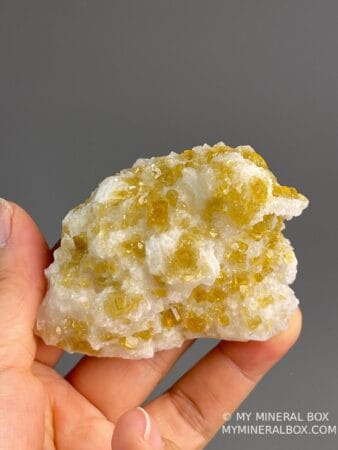
Light
Direct sunlight is the single biggest collection killer. UV bleaches fluorite (a deep purple specimen can go to colorless in a few months on a sunny shelf), darkens hackmanite, fades realgar to pararealgar, and yellows vivianite. Use UV-filtering display glass or keep the cabinet out of direct sun. LED lights with low UV output are safe; halogen and unfiltered sunlight are not.
Humidity and temperature
Pyrite, marcasite, and other iron sulfides oxidize to acidic sulfates above ~60% RH — first as a white crust, eventually destroying the specimen and any neighbors. Keep these minerals at 40–50% RH in a sealed cabinet with desiccant. Water-soluble minerals (halite, borax) require even lower humidity. Sudden temperature swings crack large quartz crystals and brittle prisms — keep the room reasonably stable.
Handling, mounting, and labels
Touch as little as possible — skin oils etch soft minerals and stain water-soluble surfaces. Use cotton gloves for valuable pieces. Mount large or unstable specimens on display bases with mineral tack (a removable putty), not permanent adhesives. Every specimen needs a catalog number (a small inked dot + number) AND a paper label inside the box with locality, mineral, dimensions, and acquisition date. A collection without provenance loses half its value at every transfer.
Choosing a display cabinet and shelving
An enclosed glass cabinet does three jobs at once: it keeps dust off delicate druzy and acicular crystals, it lets you control the internal climate, and it shields specimens from a room's ambient UV. Prefer a cabinet with a back panel and a door seal good enough to hold a stable humidity when you add silica-gel desiccant packs. Glass shelves should be thick enough not to flex under heavy matrix pieces, and felt or foam shelf liner stops a specimen from sliding if the cabinet is bumped. Position the cabinet against an interior wall away from windows, radiators, and air-conditioning vents, because temperature and humidity swings do more cumulative damage than a single mistake.
Many Chinese collectors keep specimens in apartments where summer humidity runs high and winter heating is dry — a small hygrometer inside the cabinet costs little and turns guesswork into a number you can act on.
Climate control for reactive minerals
A few species need active humidity management rather than passive care. Pyrite and marcasite decay (the crumbly, sulfurous 'pyrite disease') accelerates with moisture, so store at-risk sulfides drier than the rest of the collection. Truly soluble species — halite, and to a lesser degree borax and some sulfates — can deliquesce and lose their crystal faces in a humid room, so they belong in a sealed container with fresh desiccant and should never be rinsed in water. Recharge silica gel by drying it in a low oven when its indicator color changes, and keep a spare set so the cabinet is never left without protection. If you notice a white powdery efflorescence or a vinegar-like smell, isolate that specimen immediately before the byproducts attack neighboring pieces.
Earthquake, transport, and travel safety
Physical shock ruins more specimens than chemistry does. On open shelves, museum gel or a thin bead of removable mineral tack under the base keeps a piece from walking off the edge during a tremor or a heavy footstep. For shipping or moving house, wrap each specimen individually — soft tissue against the crystals first, then bubble wrap, then a rigid box with the piece suspended in foam peanuts so nothing touches the walls. Pack fragile terminations and thin blades so they cannot rattle, and label the box fragile and this-way-up. Never let two specimens share a compartment where a harder crystal can abrade a softer one in transit.
Frequently asked questions
How do I stop pyrite from crumbling (pyrite disease)?
Keep iron sulfides dry — roughly 40–50% relative humidity in a sealed cabinet with silica-gel desiccant. There is no reliable home cure once decay starts, so prevention by controlling humidity is the real fix. Isolate any specimen that develops a white crust or sulfur smell so it does not contaminate neighbors.
Which minerals fade in light, and how do I display them?
Purple and blue fluorite, realgar, vivianite, amethyst, rose quartz, and some other colored species can fade or darken under UV and strong sunlight. Display them behind UV-filtering glass or in a cabinet away from windows, and use low-UV LED lighting rather than halogen or direct sun.
What is the safe humidity range for a mineral cabinet?
Around 40–50% relative humidity suits most collections and protects reactive sulfides. Truly water-soluble species like halite need a drier sealed container. A small hygrometer inside the cabinet lets you keep the number stable instead of guessing.
How should I mount specimens for display without damaging them?
Use removable mineral tack or museum gel on a display base rather than permanent glue, so the piece can be lifted off cleanly later. Acrylic stands and ring mounts work well for awkward shapes. Avoid hot glue and epoxy, which leave residue and lower a specimen's value and provenance.