
Argentite
Curated by Maggie Liu · Updated:
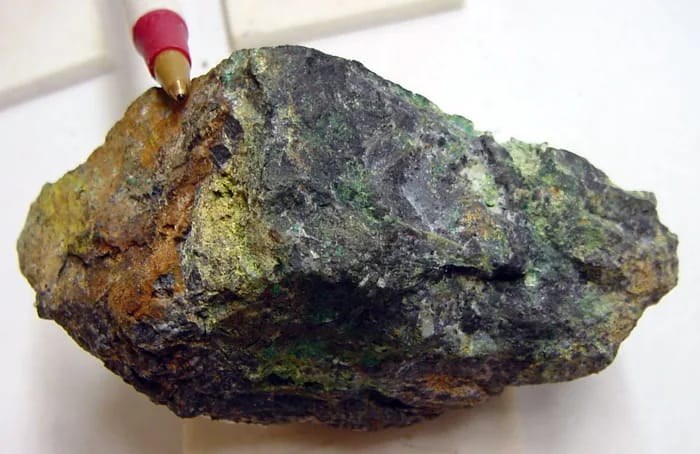
About Argentiteextended article
Argentite is a silver sulphide (Ag2S) and an important ore of silver. Strictly, 'argentite' is the high-temperature cubic form that is only stable above about 177 °C; on cooling it inverts to monoclinic acanthite, so nearly all specimens labelled argentite are in fact acanthite that has kept an external cubic or octahedral outline — paramorphs after argentite.
Properties
It is dark lead-grey to black, soft (2–2.5), and notably sectile — it can be cut with a knife like lead, leaving a shining streak. Crystals may be cubic, octahedral or wiry and dendritic, and tarnish dull on exposure.
Occurrence
Argentite/acanthite forms in hydrothermal silver veins with other silver minerals, galena and sulphosalts. Famous sources include the silver districts of Saxony (Freiberg), Příbram in Bohemia, Guanajuato in Mexico, and Kongsberg in Norway. On cooling it inverts to its low-temperature equivalent, acanthite.
Related minerals
Looking for a Argentite specimen?
Our inventory is one-of-a-kind and turns over quickly. Tell us what you're after — species, size, budget — and we'll notify you when a matching Argentite arrives from our sourcing network.
Request this mineral