
IMA Abbreviation (Whitney-Evans 2010)
Chr
→ Chromite
Fe-Cr oxide
Standard symbol from American Mineralogist (Whitney & Evans, 2010). Used in thin-section labeling, phase diagrams, and IMA-style species records.
Magnetism
Category:
weakly paramagnetic
Test result:
Slight pull from rare-earth magnet
FeCr₂O₄ — sometimes mistaken for magnetite but only weakly attracted.
Test with rare-earth magnet (N42 or N52 neodymium). Suspend specimen on thread for sensitive paramagnetic detection. Diamagnetic minerals are weakly repelled (visible only with strong magnets like bismuth).
Mohs 5.5
Vickers (~) 540 HV
Knoop (~) 620 HK
Diagnostic properties
Trace magnetism
Element composition by mass
Formula: FeCr₂O₄ · molar mass: 223.83 g/mol
| Cr | 46.46% | |
| O | 28.59% | |
| Fe | 24.95% |
Computed from atomic weights (IUPAC 2021). Site-occupancy groups (Fe,Mn) split equally.
Mohs Hardness
5.5
Chromite sits at 5.5 on the Mohs scale — just hard enough to scratch glass.
Colors:
Streak
Brown
Brown
Crystal system
Isometric (Cubic)
Isometric (Cubic)
Oxides & HydroxidesOxides
TL;DR · 1 min read
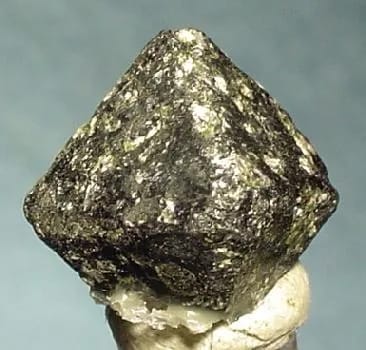
Chromite (FeCr₂O₄) is the principal chromium ore mineral and the only economically significant Cr resource. It forms in podiform and stratiform layered ultramafic intrusions — most notably the Bushveld Complex (South Africa) and the Stillwater (Montana) Complex.
Chromite (FeCr₂O₄) is the principal chromium ore mineral and the only economically significant Cr resource. It forms in podiform and stratiform layered ultramafic intrusions — most notably the Bushveld Complex (South Africa) and the Stillwater (Montana) Complex. Chromite is also the host matrix for druzy uvarovite garnet at Saranovskii (Russia).