
Chrysotile
Curated by Maggie Liu · Updated:
About Chrysotileextended article
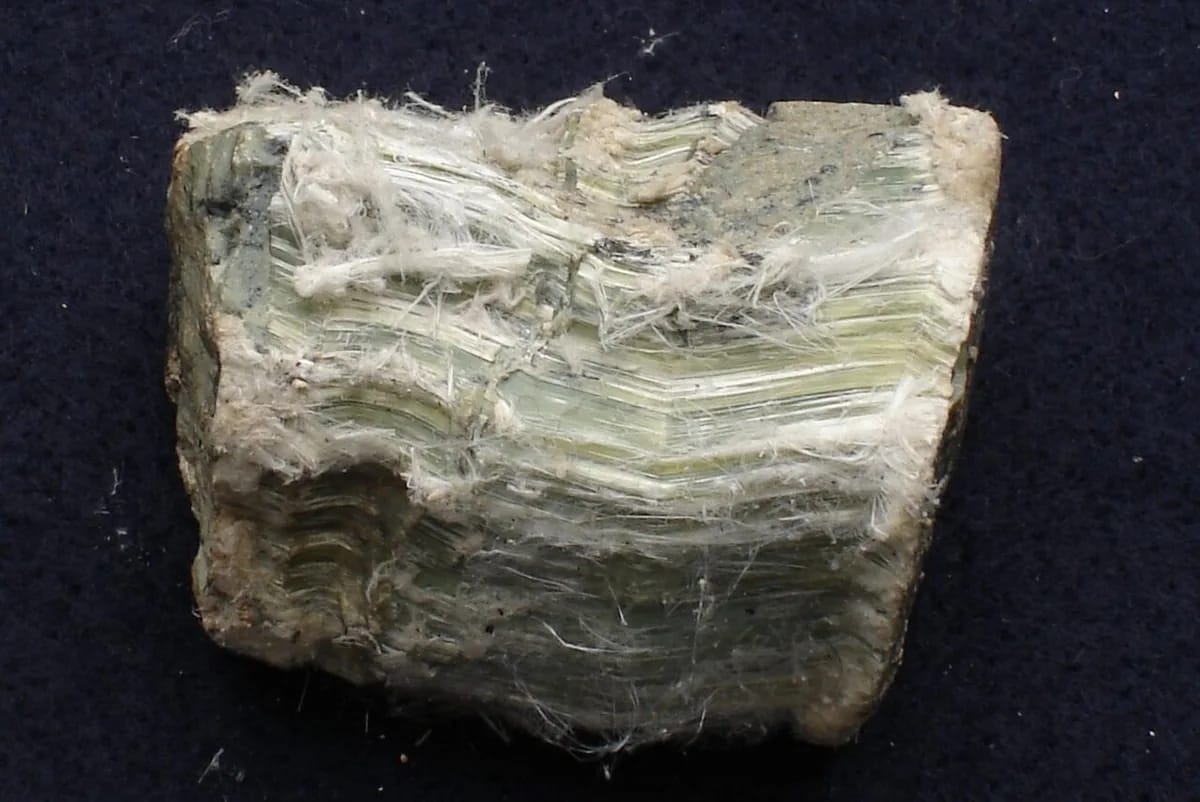
Chrysotile is a fibrous magnesium silicate of the serpentine group and the principal form of commercial asbestos. Its name, from the Greek for 'golden fibre', describes the silky, flexible, often golden-green to white fibres that can be separated and spun. Because of its health hazards its industrial use is now heavily restricted or banned.
Properties
Chrysotile is monoclinic at the structural level but appears as masses of curling, hair-like fibres with a silky lustre; it is soft (around 2.5–3) and the fibres are remarkably strong and heat-resistant. Cross-fibre veins show the characteristic perpendicular fibre growth.
Occurrence
It forms where magnesium-rich ultramafic rocks are altered by hydrothermal fluids (serpentinisation), often as veins cutting serpentinite. Major occurrences include Quebec (the Thetford and Asbestos districts), the Ural Mountains, and southern Africa. It is one of the serpentine minerals.
Frequently asked questions
What is the chemical formula of Chrysotile?
The chemical formula of Chrysotile is Mg3Si2O5(OH)4.
What crystal system does Chrysotile belong to?
Chrysotile crystallises in the Monoclinic crystal system.
Where is Chrysotile found?
Notable localities for Chrysotile include Jeffrey Mine.
Related minerals
Looking for a Chrysotile specimen?
Our inventory is one-of-a-kind and turns over quickly. Tell us what you're after — species, size, budget — and we'll notify you when a matching Chrysotile arrives from our sourcing network.
Request this mineral