
Erythrite

Crystal system · Monoclinic

Erythrite is a phosphate mineral recognized among collectors for its crystal form and distribution, with known Chinese sources.

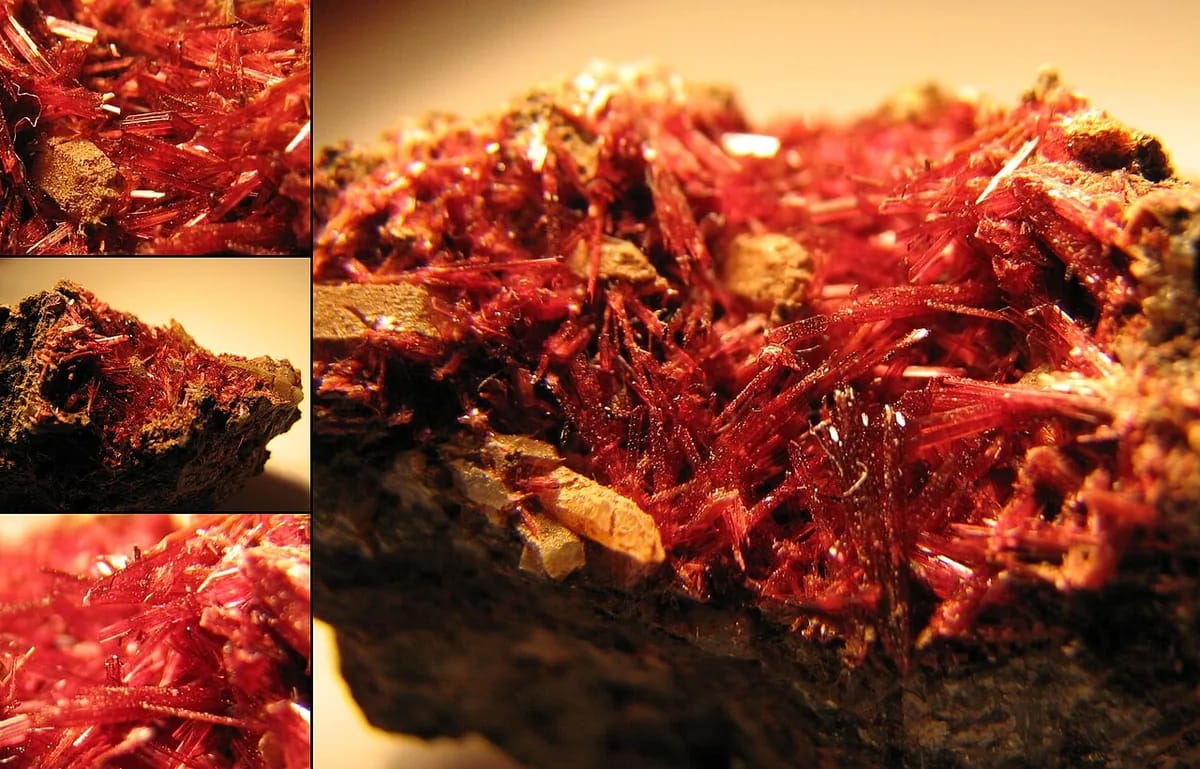
Erythrite specimen
Photo: Jarno from Rotterdam, Netherlands · CC BY 2.0 via Wikimedia Commons

About Erythriteextended article

⏳ Long-term Aging & Care Timeline
efflorescenceyears
Trigger: humidity cycles
Intervention: Pink Co arsenate; surface powder may develop. Sealed case.
Streak Test
pale red / pink
"Cobalt bloom" — pink streak of hydrated Co arsenate.
Streak = color of the powdered mineral. Drag specimen across unglazed white porcelain plate (Mohs 6.5). For minerals harder than the plate, crush a small flake into powder and observe color.
Mohs 1.5–2.5
Vickers (~) 75 HV
Knoop (~) 85 HK
Element composition by mass

Formula: Co₃(AsO₄)₂·8H₂O · molar mass: 472.65 g/mol

Co 37.41%
As 31.7%
O 30.46%
H 0.43%

Computed from atomic weights (IUPAC 2021). Site-occupancy groups (Fe,Mn) split equally.

Mohs Hardness 1.5–2.5

Erythrite sits at 1.5–2.5 on the Mohs scale — soft enough to be scratched by a fingernail.

Colors:
Streak
Pale red
Crystal system
Monoclinic
Phosphates / ArsenatesArsenates
TL;DR · 1 min read
Erythrite (Co₃(AsO₄)₂·8H₂O) is a hydrous cobalt arsenate — the secondary "cobalt bloom" alteration product of primary cobalt arsenide ores (skutterudite, cobaltite). Its diagnostic crimson-pink to magenta color is unmistakable.

Erythrite (Co₃(AsO₄)₂·8H₂O) is a hydrous cobalt arsenate — the secondary “cobalt bloom” alteration product of primary cobalt arsenide ores (skutterudite, cobaltite). Its diagnostic crimson-pink to magenta color is unmistakable. Bou Azzer (Morocco) and Schneeberg (Germany) supply iconic specimens. Toxic — handle with gloves due to soluble arsenic content.

More minerals to explore

About Erythrite

Erythrite belongs to the phosphate class in the vivianite group and has the chemical formula Co3(AsO4)2·8H2O. It crystallizes in the monoclinic system and is relatively soft, requiring careful handling. Its combination of structural character and global distribution make it a recognized species in both systematic and aesthetic collections.

Identification & care

Erythrite typically forms prismatic, acicular crystals; stellate rosette groups; reniform; earthy 'cobalt bloom'. Its color range is broad, including vivid crimson, magenta, rose pink, and purplish red (one of mineralogy's most spectacular colors). The luster is adamantine, vitreous, pearly, silky, the streak is pale rose red, and specimens range from transparent to translucent. The cleavage is perfect on {010}. The fracture is uneven, which aids identification.

Collector context

How it forms

In terms of geology, Erythrite forms in oxidized zone of cobalt and nickel arsenide deposits; 'cobalt bloom' indicates cobalt mineralization to miners. It is commonly found in association with smaltite, skutterudite, native silver, annabergite (ni analog), calcite, malachite.

Classic Chinese localities

Erythrite is widely represented across Chinese provinces, including Yunnan, Jiangxi, Qinghai.

Why collectors care

Collectors pursue Erythrite for the clarity of its crystal form and, in good material, saturated color that reads instantly across a display case. A well-terminated erythrite on clean matrix photographs well, identifies quickly, and anchors a cabinet piece. Top Chinese specimens over the last two decades have reset the bar for what erythrite looks like at collector grade.

What affects value

Value in Erythrite is assessed, in typical order of weight, against: (1) locality provenance; (2) size relative to the species norm; (3) crystal form and termination sharpness; (4) color saturation and zoning; (5) transparency and internal clarity; (6) matrix quality and aesthetic balance; (7) condition (absence of damage, chips, or repair). Cleaning quality and verified locality documentation act as multipliers across the above.

Naming history

The name Erythrite has a specific etymological and historical context — see Mindat's reference entry for provenance details. We have retained naming data at the record level; published prose is paraphrased from factual fields rather than copied from source.

Frequently asked questions

What is Erythrite?

Erythrite is a phosphate mineral recognized among collectors for its crystal form and distribution, with known Chinese sources.

What crystal system does Erythrite belong to?

Erythrite crystallises in the Monoclinic crystal system.

Where is Erythrite found?

Notable localities for Erythrite include Bou Azzer.

References & databases

Mindat.org is the world’s largest open mineralogy database. Our descriptions are written independently and fact-checked.