
Kunzite
Curated by Maggie Liu · Updated:
Kunzite is the pink-to-lilac variety of spodumene, a lithium aluminum silicate. The color comes from trace manganese and is intensified or faded by sunlight exposure.
About Kunziteextended article
Kunzite is the pink-to-lilac gem variety of spodumene, a lithium aluminium pyroxene. Its delicate colour comes from traces of manganese. It was first described in 1902 and named after the gemmologist George Frederick Kunz. Its green, chromium-coloured sister variety is hiddenite.
Properties
Spodumene is monoclinic with perfect prismatic cleavage and a hardness of 6.5–7, which — together with strong pleochroism — makes kunzite a difficult stone to cut well; lapidaries orient it to show the deepest pink down the length of the crystal. The colour of some stones can fade with prolonged exposure to strong light.
Occurrence
Kunzite forms in lithium-rich granitic pegmatites. The Pala district of California, Afghanistan, Pakistan, Brazil and Madagascar are leading sources, often yielding very large, gemmy crystals.
About Kunzite
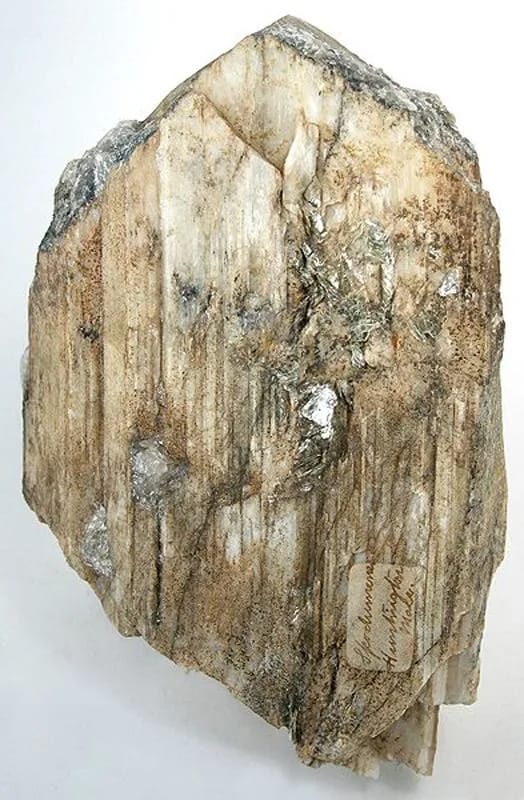
Kunzite is spodumene (LiAlSi2O6) colored by trace manganese. The mineral was named in 1902 after George Frederick Kunz, the famous Tiffany gemologist who first described it from California. Spodumene is one of the chief lithium ores and crystallizes in pegmatites, often as huge tabular crystals — single Brazilian crystals weigh tens of kilograms. The pink-lilac color of kunzite is unstable in strong sunlight and will fade over years.
Identification & care
Kunzite has a Mohs hardness of 6.5 to 7 and specific gravity around 3.18. It is strongly pleochroic, showing colorless to deep pink along different crystal axes. Cleavage is perfect in two directions at nearly 90 degrees, parallel to the c-axis — a key cutting challenge. Luster is vitreous, no fluorescence, fracture is uneven. Crystals are typically prismatic with flat terminations and prominent striations.
Collector context
Collector notes
Brazil (Minas Gerais), Afghanistan (Nuristan), Pakistan (Mawi), and Madagascar are the main commercial sources. Specimen value scales with color saturation, transparency, crystal completeness, and matrix presence. The fading issue means dealers should store specimens in subdued light; collectors who display kunzite in direct sunlight will see noticeable color loss within a few years. Hiddenite (the green chromiferous variety) is a closely related species.
Frequently asked questions
What is Kunzite?
Kunzite has the chemical formula LiAlSi2O6, crystallises in the Monoclinic system, has a Mohs hardness of 6.5–7.5. Kunzite is the pink-to-lilac variety of spodumene, a lithium aluminum silicate. The color comes from trace manganese and is intensified or faded by sunlight exposure.
What is the chemical formula of Kunzite?
The chemical formula of Kunzite is LiAlSi2O6.
What crystal system does Kunzite belong to?
Kunzite crystallises in the Monoclinic crystal system.
Where is Kunzite found?
Notable localities for Kunzite include Pala District, Kunar Valley.
Is Kunzite rare?
As a collector mineral, Kunzite is generally considered uncommon.
Related minerals
Looking for a Kunzite specimen?
Our inventory is one-of-a-kind and turns over quickly. Tell us what you're after — species, size, budget — and we'll notify you when a matching Kunzite arrives from our sourcing network.
Request this mineral