
Lazurite
Curated by Maggie Liu · Updated:
About Lazuriteextended article
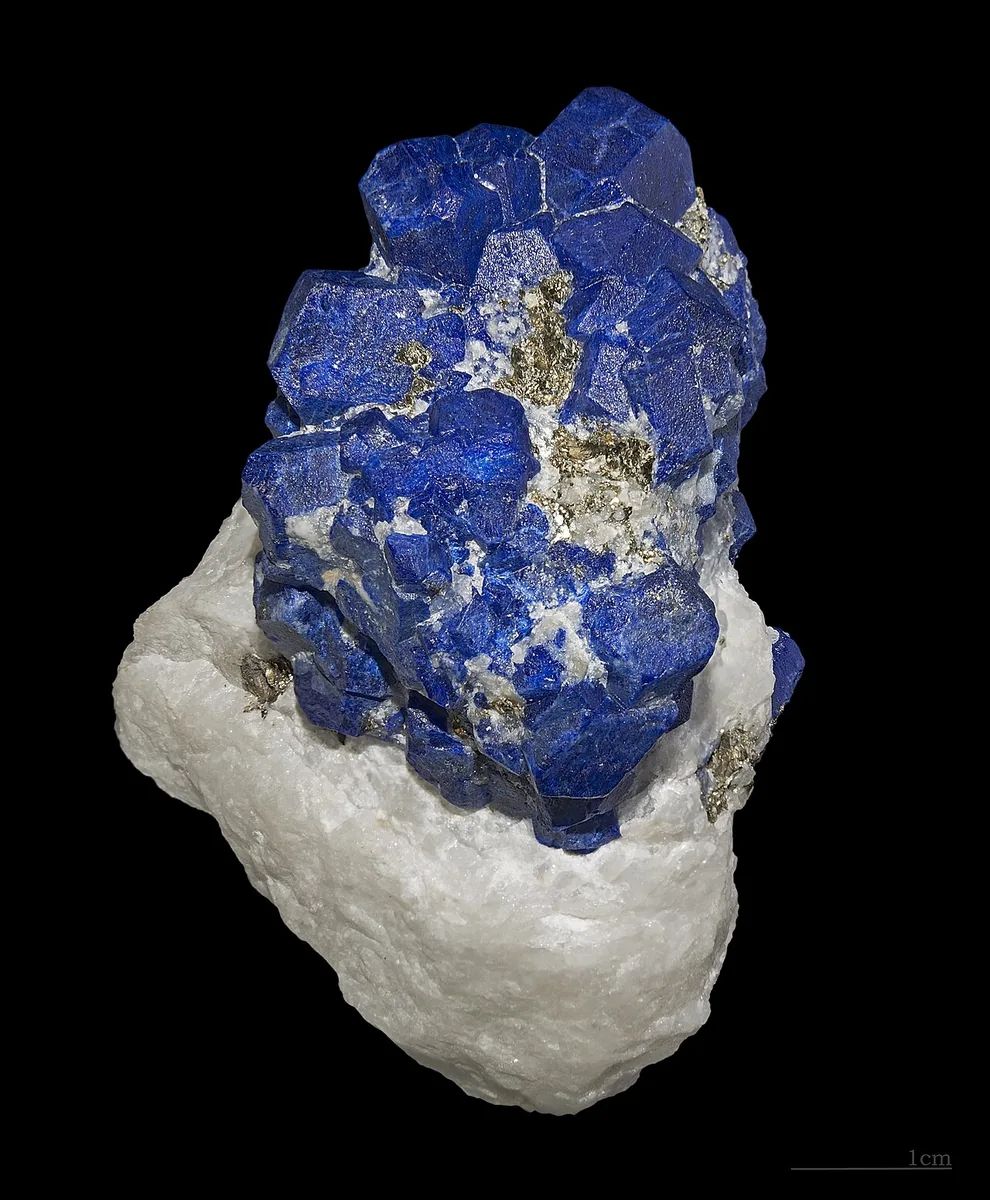
Lazurite is the deep-blue feldspathoid that gives the ornamental rock lapis lazuli its colour. It is a sodium-calcium aluminosilicate of the sodalite group that also carries sulphur, which is responsible for its intense ultramarine blue — the pigment of the same name was once made by grinding lapis.
Properties
Lazurite is isometric, relatively soft (5–5.5) and usually occurs massive rather than as clean crystals; in lapis it is intergrown with calcite and flecks of golden pyrite. The best colour is an even, saturated violet-blue with minimal calcite.
Occurrence
It forms by contact metamorphism of limestone. The classic source, mined for thousands of years, is Sar-e-Sang in Badakhshan, Afghanistan; other deposits occur near Lake Baikal in Russia and in the Chilean Andes. Lazurite is the key component of lapis lazuli.
Frequently asked questions
What is the chemical formula of Lazurite?
The chemical formula of Lazurite is Na3CaAl3Si3O12S.
What crystal system does Lazurite belong to?
Lazurite crystallises in the Isometric crystal system.
Where is Lazurite found?
Notable localities for Lazurite include Sar-i-Sang.
Related minerals
Looking for a Lazurite specimen?
Our inventory is one-of-a-kind and turns over quickly. Tell us what you're after — species, size, budget — and we'll notify you when a matching Lazurite arrives from our sourcing network.
Request this mineral