
Peridot
Curated by Maggie Liu · Updated:
Peridot is the gem-quality yellow-green variety of olivine, valued for its single vivid green colour.
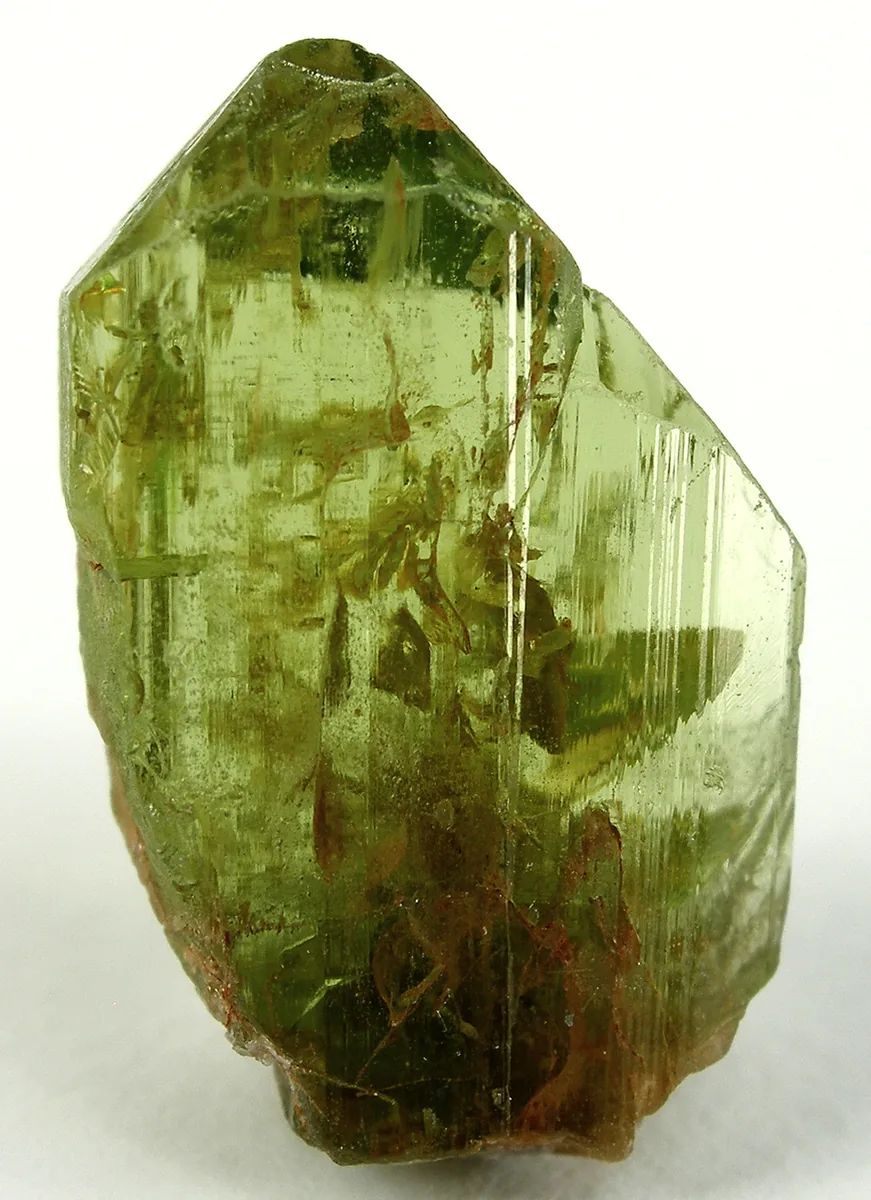
Peridot is the gem-quality, yellow-green variety of olivine, one of the few gemstones that occurs in only one colour.
About Peridotextended article
Peridot is the transparent, gem-quality variety of the mineral olivine. It is one of the few gems that comes in essentially a single colour — a distinctive yellow-green to olive-green — with the most vivid greens in iron-poor crystals.
Identifying peridot
Peridot is moderately hard (6.5–7), with a glassy lustre and a strong doubling of back facets under magnification (high birefringence). Its lively yellow-green colour, unchanging under different light, is characteristic. It forms in mantle-derived basalts and peridotites and even in some pallasite meteorites.
Where it is found
Historic and modern sources include the island of Zabargad in the Red Sea, the Sapat valley of Pakistan, San Carlos in Arizona, Myanmar and China. Large, clean crystals from Pakistan are especially prized.
For collectors
Saturated green colour, transparency and crystal size drive value; sharp gemmy crystals on matrix and faceted stones are both sought after.
Frequently asked questions
What is Peridot?
Peridot has the chemical formula (Mg,Fe)2SiO4, crystallises in the Orthorhombic system, has a Mohs hardness of 6.5–7. Peridot is the gem-quality yellow-green variety of olivine, valued for its single vivid green colour.
What is the chemical formula of Peridot?
The chemical formula of Peridot is (Mg,Fe)2SiO4.
What crystal system does Peridot belong to?
Peridot crystallises in the Orthorhombic crystal system.
Where is Peridot found?
Notable localities for Peridot include Zabargad Island, San Carlos.
Related minerals
Looking for a Peridot specimen?
Our inventory is one-of-a-kind and turns over quickly. Tell us what you're after — species, size, budget — and we'll notify you when a matching Peridot arrives from our sourcing network.
Request this mineral