
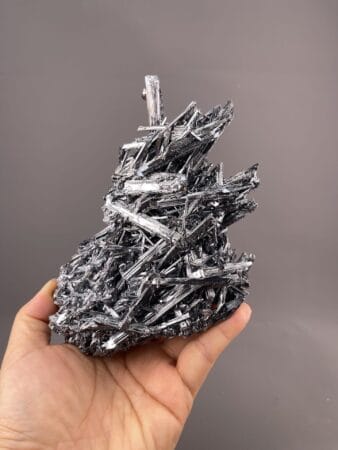
The fluid path
Heat (from a cooling magma body, deep burial, or both) drives groundwater through cracks in the rock. The water dissolves metals and other elements from surrounding rock as it migrates. When the fluid hits a temperature drop, pressure drop, or chemistry change (often a different host rock), the dissolved load precipitates as crystals on the fracture walls.
Open-space growth
Crystals grow inward from the fracture walls into an open void. With nothing to push against, they develop large euhedral (well-formed) faces. This is why vein and vug specimens have such clean crystal terminations compared to rock-bound minerals from metamorphic environments. Crustification — sequential layered growth as the fluid chemistry shifted — records the geological history of the vein in cross-section.
Famous vein associations
Sulfide-quartz veins: galena, sphalerite, chalcopyrite, pyrite, quartz, often capped by calcite. Tungsten-tin veins (Yaogangxian, Xuebaoding): wolframite, cassiterite, scheelite, fluorite, quartz. Antimony veins (Lengshuijiang): stibnite, quartz, calcite. Each combination tells you something about the temperature and chemistry of the parent fluid — the same toolkit professional mineralogists use to interpret economic deposits.
Reading the paragenetic sequence
Paragenesis is the order in which minerals crystallized as a vein cooled, and you can often read it straight off the specimen. Earlier minerals sit against the vein wall and get overgrown by later ones, so a quartz crystal coated by a thin skin of fluorite tells you fluorite came last. Crustification bands — repeating layers parallel to the wall — are a literal timeline of the fluid's changing chemistry.
Learning the sequence helps you judge a specimen and predict what else a pocket might yield. On many Chinese tungsten veins the high-temperature minerals (wolframite, cassiterite) form first, with fluorite, calcite, and quartz arriving later as the system cooled, which is why glassy late-stage fluorite so often perches on top of the earlier metallics.
China's hydrothermal vein belts
Southern China hosts some of the world's most productive specimen-bearing hydrothermal systems, repeatedly tied to granite intrusions of Jurassic age. In Hunan, the Yaogangxian tungsten veins yield purple-and-green fluorite with wolframite, scheelite, and arsenopyrite, while the Lengshuijiang antimony district produces the long bladed stibnite the region is known for.
In Sichuan, the Xuebaoding deposit near Pingwu is famous for scheelite, cassiterite, and beryl grown in greisen-and-vein settings around granite. Guangdong's Fankou belt is a major lead-zinc system producing galena and sphalerite. Knowing which belt a specimen came from lets you anticipate its likely associates, because each parent fluid carried a characteristic metal load.
Vein deposits versus skarn and pegmatite
Not every fine specimen comes from a vein, and telling the settings apart sharpens your reading of a locality. A skarn forms where hot fluids react with limestone at an intrusion's contact, producing calc-silicate minerals and ores like the magnetite, calcite, and pyrite of Daye in Hubei — chemistry-driven replacement rather than simple fracture-filling.
Pegmatites are very coarse igneous rocks crystallized from the last water-rich melt of a granite, sometimes overlapping with greisen-vein systems like Xuebaoding. Open-space hydrothermal veins are defined by crystals growing freely into fractures and vugs, which is what gives them their clean terminations and crustified layers. Recognizing the setting explains both the mineral association and the typical crystal quality you can expect.
Frequently asked questions
Why do hydrothermal veins produce such well-formed crystals?
Vein crystals grow into open voids in the rock, so they have room to develop complete, sharp faces with nothing pressing against them. That open-space growth is why vein and vug specimens show cleaner terminations than minerals locked inside solid metamorphic rock.
What minerals commonly occur together in hydrothermal veins?
Associations depend on the parent fluid: sulfide-quartz veins carry galena, sphalerite, pyrite, and quartz often capped by calcite, while tungsten-tin veins like Yaogangxian carry wolframite, cassiterite, scheelite, and fluorite. The mineral combination is a fingerprint of the fluid's temperature and chemistry.
Why is so much Chinese fluorite from hydrothermal veins?
Southern China's Jurassic granites drove repeated hydrothermal systems that deposited fluorite alongside tungsten and other ores, especially in Hunan. Late-stage cooling fluids favored fluorite, so it crystallized in open vugs as glassy, well-formed cubes such as those from Yaogangxian.
How is a hydrothermal vein different from a skarn?
A vein forms when mineral-rich fluids fill open fractures and crystals grow into the void. A skarn forms when those fluids react chemically with limestone at an intrusion's contact, replacing rock with calc-silicate minerals and ore, as at Daye in Hubei.