
Subscripts and parentheses
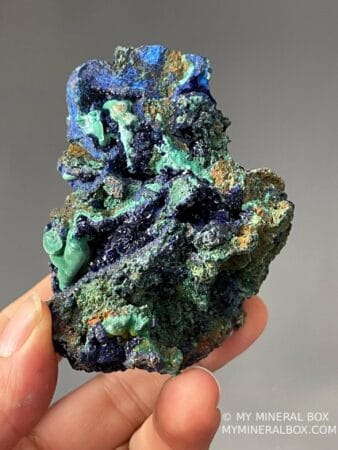
A subscript counts atoms. CaF₂ means one calcium for every two fluorines — that's fluorite. Parentheses group an atom cluster that repeats as a unit. Cu₃(CO₃)₂(OH)₂ — azurite — has three coppers, two carbonate groups, and two hydroxyl groups. The parentheses tell you those groups stay bonded together throughout the structure.
The anion classification
Minerals are sorted scientifically by their dominant anion. Silicates (SiO₄ tetrahedra) make up 90% of crustal minerals. Carbonates (CO₃) include calcite, aragonite, dolomite, azurite, malachite. Sulfides (S) include galena, pyrite, sphalerite, stibnite. Oxides (O) include hematite, magnetite, cassiterite. Halides (Cl/F/Br) include halite and fluorite. Sulfates (SO₄), phosphates (PO₄), and tungstates (WO₄) round out the rest.
Reading complex formulas
Tourmaline's formula — (Na,Ca)(Mg,Li,Al,Fe)₃Al₆Si₆O₁₈(BO₃)₃(OH)₄ — looks brutal until you read it group by group. Comma-separated elements inside parentheses share a crystallographic site. Boron clusters as borate (BO₃) groups. Silicon clusters as a six-membered ring (Si₆O₁₈). Even the most fearsome formula is just a stack of structural ingredients.
Cations vs. anions: who's holding hands with whom
A formula divides into the positively charged metals (cations) on the left and the negatively charged groups (anions) on the right. The cation is usually what gives a mineral its color and name appeal — copper turns azurite and malachite blue and green, iron makes many minerals dark. The anion group is what classifies the species and largely sets its physical behavior: a carbonate fizzes in acid, a sulfide oxidizes in air, a silicate is hard and chemically tough.
Reading in this order — cation first, then the dominant anion — tells you most of what you need before you ever touch the specimen. Cu₂CO₃(OH)₂ (malachite) reads as 'a copper carbonate,' which already predicts the green color, the soft hardness near 3.5–4, and the brisk reaction to dilute acid. Train yourself to ask 'what metal, what group?' and the formula stops being a wall of symbols.
Common formula-reading mistakes
The most frequent error is misreading parentheses with an outside subscript: in Cu₃(CO₃)₂(OH)₂ the '₂' after (CO₃) multiplies the entire carbonate group, giving two carbons and six oxygens from that part alone — not two oxygens. Another trap is treating commas as 'and' when they actually mean 'or, in varying proportion': (Mg,Fe) means magnesium and iron substitute for each other on the same site, which is why olivine and many garnets grade continuously in composition rather than being fixed recipes.
A third pitfall is forgetting that water can be structural. A raised dot, as in CaSO₄·2H₂O (gypsum), means water molecules sit in the lattice as a real component — heat the mineral and it can dehydrate to a different species. Reading these three features correctly — group subscripts, substitution commas, and bound water — clears up the large majority of confusion over textbook formulas.
Formulas behind classic Chinese specimens
China's most collected species are an ideal place to practice, because their formulas map cleanly onto what you can see and feel. Yaogangxian and Shangbao in Hunan produce fluorite, CaF₂ — a simple halide, which is why it is only moderately hard and cleaves so readily on octahedral planes. Xuebaoding in Sichuan yields scheelite, CaWO₄, a tungstate; the heavy tungsten atom explains the surprising weight of even a small crystal and its bright blue-white fluorescence under shortwave UV.
The sulfide and carbonate districts reinforce the same habit of reading. Stibnite from the Lengshuijiang area in Hunan is Sb₂S₃, an antimony sulfide — soft, steely, and prone to surface tarnish exactly as a sulfide formula predicts. Calcite from Daye in Hubei is CaCO₃, a carbonate that fizzes in dilute acid on contact. Handle a few of these alongside their formulas and the link between symbols and specimen becomes second nature.
Frequently asked questions
What does a number written below the line in a formula mean?
A subscript counts how many of the preceding atom or group are present. CaF₂ has one calcium and two fluorines per formula unit. If there is no subscript, the count is one.
Why do some mineral formulas have commas inside parentheses?
Commas mark elements that substitute for one another on the same crystallographic site, in variable proportion. (Mg,Fe)₂SiO₄ means magnesium and iron share a site, which is why olivine ranges in composition rather than having a single fixed recipe.
What does the raised dot in a formula like CaSO₄·2H₂O mean?
The dot indicates water that is built into the crystal structure — here, two water molecules per formula unit in gypsum. Such minerals can lose that water when heated and change into a different species.
Do I need to memorize formulas to identify minerals?
No. Most field identification relies on crystal system, hardness, streak, and luster. Formulas are useful for understanding why a mineral behaves as it does — for instance why a carbonate fizzes in acid or a sulfide tarnishes — rather than for on-the-spot ID.