
Crystal Structure
Fe₃Al₂(SiO₄)₃.
Elemental Composition (by mass)
| Element | Mass % | Visual |
|---|---|---|
| O Oxygen | 38.57% | |
| Fe Iron | 33.66% | |
| Si Silicon | 16.93% | |
| Al Aluminum | 10.84% |
Computed from simplified end-member formula. Solid-solution series, water content, and trace substitutions cause real-world variation.
IMA Abbreviation (Whitney-Evans 2010)
Alm
→ Almandine
Garnet
Standard symbol from American Mineralogist (Whitney & Evans, 2010). Used in thin-section labeling, phase diagrams, and IMA-style species records.
Pronunciation
/ˈælməndiːn/
↔ AL-mun-deen
from Alabanda (Turkey)
Lapidary & Faceting Recommendations
Recommended cut:
oval / cushion
Also seen:
cushion, oval, cabochon
Typical yield:
30% of rough
Bohemian almandine traditionally cabbed; gem-grade pyrope can be faceted as cushion.
Tenacity
Behavior:
brittle
Under stress:
Same as garnet
Same.
Luster
vitreous
Standard vitreous.
Color Cause (Chromophore)
Chromophore:
Fe²⁺
Mechanism:
idiochromatic
Color produced:
red-purple
Pure Fe-Al garnet; deeper red than pyrope.
Diaphaneity (Transparency)
transparent-to-translucent
Fe-Al garnet.
Magnetism
Category:
weakly paramagnetic
Test result:
Detectable pull with N52 neodymium
Fe-rich garnet — strongest paramagnetic garnet.
Test with rare-earth magnet (N42 or N52 neodymium). Suspend specimen on thread for sensitive paramagnetic detection. Diamagnetic minerals are weakly repelled (visible only with strong magnets like bismuth).
Specific Gravity
3.95–4.32
g/cm³
heavy
Fe-Al garnet; heaviest pyralspite garnet.
For comparison: water = 1.00, glass ≈ 2.5, quartz = 2.65, corundum ≈ 4.00, galena ≈ 7.50, gold ≈ 19.3.
Geological Setting
Index mineral of medium-grade pelitic metamorphism.
Cleavage & Fracture
Cleavage:
none —
Fracture:
conchoidal
Brittle conchoidal fracture.
Market availability: Common
Widely available in most dealer stocks. Specimens span all price tiers.
Collector tier: Solid Display
Reliable mid-tier display species. Easy to find in well-formed examples; broad locality diversity.
Mohs 7–7.5
Vickers (~) 1400 HV
Knoop (~) 1100 HK
Geological setting
Metamorphic
Element composition by mass
Formula: Fe₃Al₂(SiO₄)₃ · molar mass: 497.74 g/mol
| O | 38.57% | |
| Fe | 33.66% | |
| Si | 16.93% | |
| Al | 10.84% |
Computed from atomic weights (IUPAC 2021). Site-occupancy groups (Fe,Mn) split equally.
GroupGarnet Group
Mohs Hardness
7–7.5
Almandine sits at 7–7.5 on the Mohs scale — harder than glass; scratches steel.
Colors:
Streak
White
White
Crystal system
Isometric (Cubic)
Isometric (Cubic)
Discovery First described 1546 by Georgius Agricola
SilicatesSilicates (Nesosilicates)
TL;DR · 1 min read
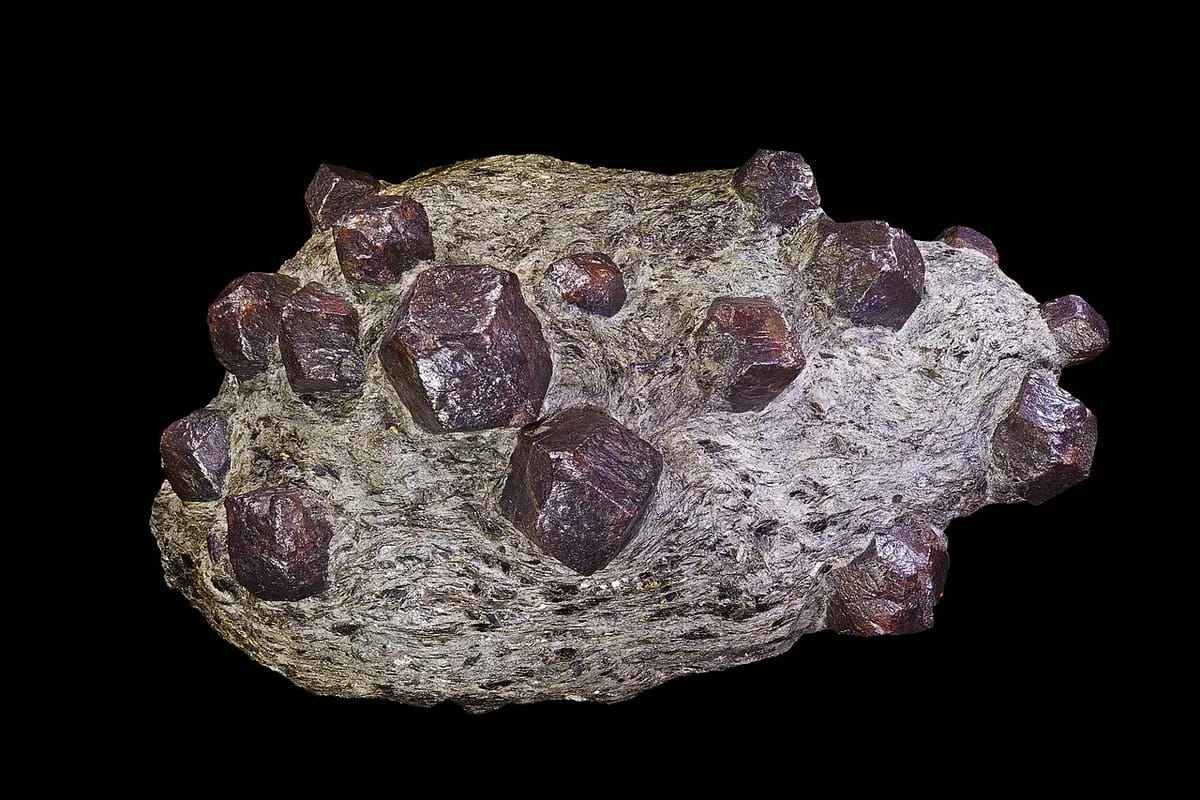
Almandine (Fe₃Al₂(SiO₄)₃) is the iron-rich end-member of the garnet group and the most common garnet species. Its deep wine-red to brownish-red dodecahedral crystals are widely collected and produce classic garnet sand and metamorphic-rock crystal accumulations.
Almandine (Fe₃Al₂(SiO₄)₃) is the iron-rich end-member of the garnet group and the most common garnet species. Its deep wine-red to brownish-red dodecahedral crystals are widely collected and produce classic garnet sand and metamorphic-rock crystal accumulations. Almandine forms in regional metamorphic schists and gneisses, where it grows as well-formed isometric crystals embedded in a matrix of mica and quartz.
More minerals to explore
Grossular (钙铝榴石)
Isometric (Cubic)
Euclase (蓝柱石)
Monoclinic
Uvarovite (钙铬榴石)
Isometric (Cubic)
Phenakite (似晶石)
Trigonal
Staurolite (十字石)
Monoclinic
Kyanite (蓝晶石)
Triclinic
Other Members of the Garnet Group
石榴石族
- Andradite (钙铁榴石)
- Grossular (钙铝榴石)
- Pyrope (镁铝榴石)
- Spessartine (锰铝榴石)
- Uvarovite (钙铬榴石)