
Babingtonite
Curated by Maggie Liu · Updated:
Babingtonite is an inosilicate mineral recognized among collectors for its crystal form and distribution, with known Chinese sources.
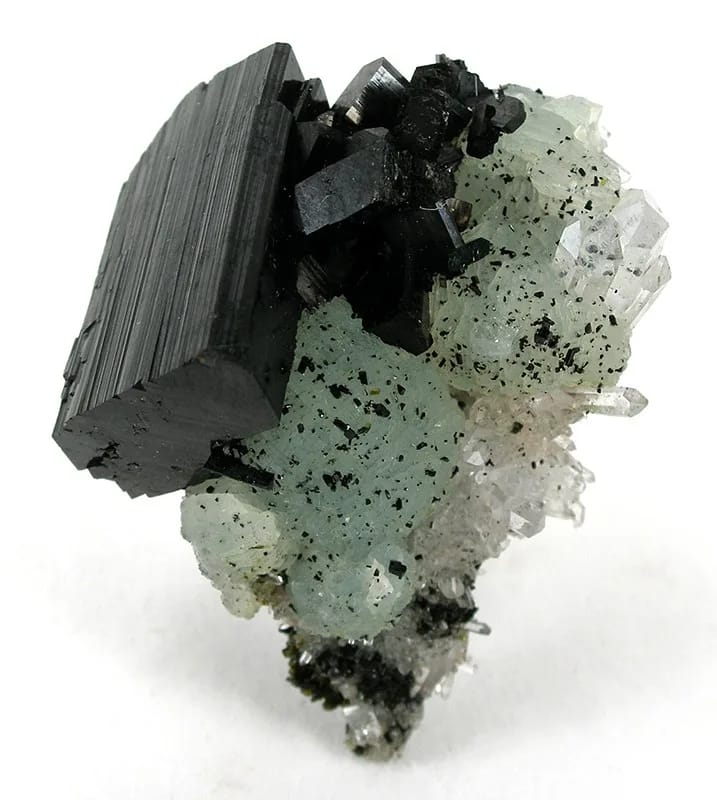
Babingtonite is a dark green-black calcium-iron silicate of skarns and basalt cavities, a sought-after collector species best known in China from the Huanggang Mine in Inner Mongolia.
About Babingtoniteextended article
Babingtonite is a calcium-iron inosilicate that forms in skarns, hydrothermal veins, and cavities in basalt. Its dark green to greenish-black crystals — with a bright vitreous lustre and sharp, wedge-shaped habit — make it a prized small-cabinet and miniature collector species.
The Chinese angle
The Huanggang iron-tin skarn in Inner Mongolia has produced fine lustrous babingtonite, often with the ilvaite, hedenbergite, and quartz that characterise the deposit — adding to Huanggang’s reputation as one of the great modern skarn localities.
What collectors look for
Crystal sharpness, the deep green-black colour with its bright lustre, size (the species rarely forms large crystals), and an undamaged termination drive value. Aesthetic associations on contrasting matrix are especially prized.
About Babingtonite
Babingtonite belongs to the inosilicate class in the babingtonite group and has the chemical formula Ca2(Fe2+,Mn)Fe3+Si5O14(OH). It crystallizes in the triclinic system and holds a steady position among inosilicate species.
Identification & care
Crystals commonly develop as short prismatic, tabular crystals with complex faces; often well-formed; radial groups. Its color is typically greenish black, dark green and black. The luster is vitreous to resinous, the streak is gray-green, and specimens range from translucent to opaque. The cleavage is perfect {001}, good {010}. The fracture is uneven, which aids identification.
Collector context
Collector notes
Babingtonite holds a steady place in systematic mineral collections. Babingtonite is widely represented across Chinese provinces, including Yunnan, Sichuan, Hubei.
Frequently asked questions
What is Babingtonite?
Babingtonite has the chemical formula Ca2(Fe2+,Mn)Fe3+Si5O14(OH), crystallises in the Triclinic system. Babingtonite is an inosilicate mineral recognized among collectors for its crystal form and distribution, with known Chinese sources.
What is the chemical formula of Babingtonite?
The chemical formula of Babingtonite is Ca2(Fe2+,Mn)Fe3+Si5O14(OH).
What crystal system does Babingtonite belong to?
Babingtonite crystallises in the Triclinic crystal system.
Where is Babingtonite found?
Notable localities for Babingtonite include Huanggang Mine.
Related minerals
Looking for a Babingtonite specimen?
Our inventory is one-of-a-kind and turns over quickly. Tell us what you're after — species, size, budget — and we'll notify you when a matching Babingtonite arrives from our sourcing network.
Request this mineral