
Elemental Composition (by mass)
| Element | Mass % | Visual |
|---|---|---|
| O Oxygen | 38.69% | |
| Si Silicon | 22.64% | |
| Fe Iron | 22.51% | |
| Ca Calcium | 16.15% |
Computed from simplified end-member formula. Solid-solution series, water content, and trace substitutions cause real-world variation.
IMA Abbreviation (Whitney-Evans 2010)
Hd
→ Hedenbergite
Ca-Fe pyroxene
Standard symbol from American Mineralogist (Whitney & Evans, 2010). Used in thin-section labeling, phase diagrams, and IMA-style species records.
Magnetism
Category:
weakly paramagnetic
Test result:
Strong for a non-ore silicate
Fe end-member of diopside-hedenbergite series.
Test with rare-earth magnet (N42 or N52 neodymium). Suspend specimen on thread for sensitive paramagnetic detection. Diamagnetic minerals are weakly repelled (visible only with strong magnets like bismuth).
Collector tier: Micromount / Niche
Best appreciated at thumbnail or smaller scale — often dull-colored, sub-millimeter, or radioactive. Specialist appeal.
Mohs 5.5–6.5
Vickers (~) 820 HV
Knoop (~) 870 HK
Geological setting
SkarnSedimentary
Element composition by mass
Formula: CaFeSi₂O₆ · molar mass: 248.09 g/mol
| O | 38.69% | |
| Si | 22.64% | |
| Fe | 22.51% | |
| Ca | 16.15% |
Computed from atomic weights (IUPAC 2021). Site-occupancy groups (Fe,Mn) split equally.
Mohs Hardness
5.5–6.5
Hedenbergite sits at 5.5–6.5 on the Mohs scale — just hard enough to scratch glass.
Colors:
Streak
Gray-green
Gray-green
Crystal system
Monoclinic
Monoclinic
SilicatesSilicates (Inosilicates — Pyroxenes)
TL;DR · 1 min read
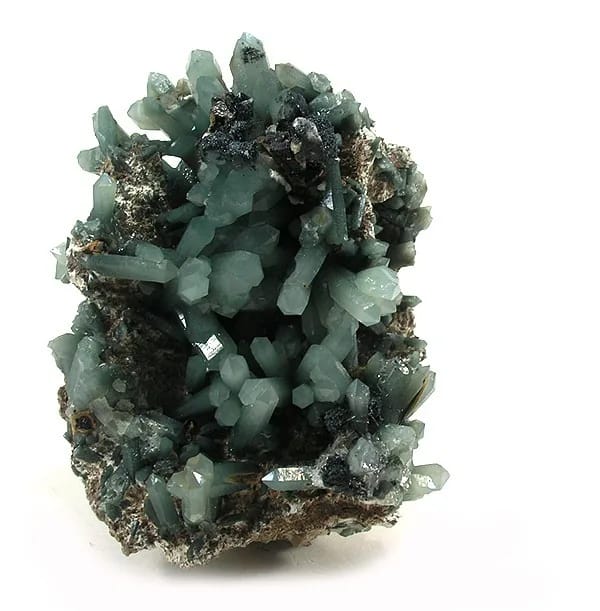
Hedenbergite (CaFeSi₂O₆) is the iron-rich end-member of the diopside-hedenbergite continuous series in the calcium clinopyroxene group. It forms classic skarn assemblages at the contact between iron-rich rocks and limestone, producing dark green to black prismatic crystals on calcite or magnetite matrix.
Hedenbergite (CaFeSi₂O₆) is the iron-rich end-member of the diopside-hedenbergite continuous series in the calcium clinopyroxene group. It forms classic skarn assemblages at the contact between iron-rich rocks and limestone, producing dark green to black prismatic crystals on calcite or magnetite matrix. Famous from Nordmark (Sweden) and Sichuan/Liaoning skarn deposits.