
Elemental Composition (by mass)
| Element | Mass % | Visual |
|---|---|---|
| O Oxygen | 47.28% | |
| Si Silicon | 18.44% | |
| Al Aluminum | 17.72% | |
| Mg Magnesium | 7.98% | |
| B Boron | 3.55% | |
| Na Sodium | 2.52% | |
| F Fluorine | 2.08% | |
| H Hydrogen | 0.44% |
Computed from simplified end-member formula. Solid-solution series, water content, and trace substitutions cause real-world variation.
IMA Abbreviation (Whitney-Evans 2010)
Drv
→ Dravite
Mg-tourmaline
Standard symbol from American Mineralogist (Whitney & Evans, 2010). Used in thin-section labeling, phase diagrams, and IMA-style species records.
Mohs 7–7.5
Vickers (~) 1400 HV
Knoop (~) 1100 HK
Geological setting
PegmatiteMetamorphicSedimentaryEvaporite
Element composition by mass
Formula: NaMg₃Al₆(BO₃)₃Si₆O₁₈(OH)₄ · molar mass: 958.74 g/mol
| O | 51.73% | |
| Si | 17.58% | |
| Al | 16.89% | |
| Mg | 7.61% | |
| B | 3.38% | |
| Na | 2.4% | |
| H | 0.42% |
Computed from atomic weights (IUPAC 2021). Site-occupancy groups (Fe,Mn) split equally.
Mohs Hardness
7–7.5
Dravite sits at 7–7.5 on the Mohs scale — harder than glass; scratches steel.
Colors:
Streak
White
White
Crystal system
Trigonal
Trigonal
SilicatesSilicates (Cyclosilicates)
TL;DR · 1 min read
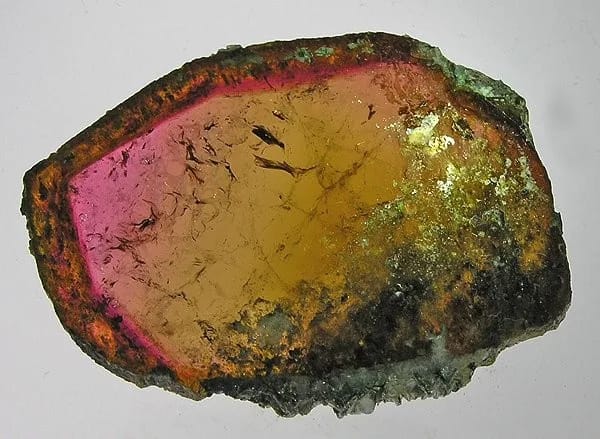
Dravite (NaMg₃Al₆(BO₃)₃Si₆O₁₈(OH)₄) is the magnesium-rich end-member of the tourmaline group, completing the species trio with iron-rich Schorl and lithium-rich Elbaite. Its name comes from the Drave (Drava) River valley in Carinthia, Austria — its type locality. Dravite typically forms brown to yellow-brown prismatic crystals in metamorphic dolomitic marbles, contact aureoles, and sedimentary borate environments.
More minerals to explore
Elbaite (锂电气石)
Trigonal
Benitoite (蓝锥矿)
Hexagonal
Beryl (绿柱石)
Hexagonal
Schorl (黑电气石)
Trigonal
Sugilite (舒俱徕石)
Hexagonal
Uvite (钙镁电气石)
Trigonal
Other Members of the Tourmaline Group
电气石族