
Eudialyte
Curated by Maggie Liu · Updated:
Eudialyte is a silicate mineral prized by collectors for its exceptional color range, with known Chinese sources.
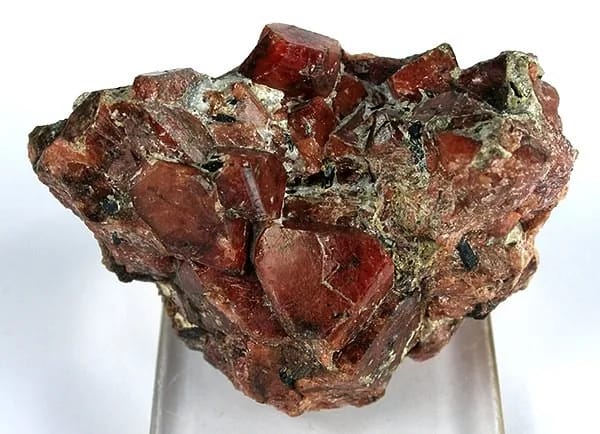
About Eudialyte
Eudialyte is classified as a silicate mineral in the eudialyte group and has the chemical formula Na15Ca6(Fe,Mn)3Zr3[Si25O73](OH,H2O,Cl)3. It crystallizes in the trigonal system and is one of the most visually varied minerals in the collector market.
Identification & care
Eudialyte typically forms tabular crystals; massive; disseminated grains in alkaline rocks. Its color range is broad, including red, pink, brownish red, orange, and yellow (vibrant). The luster is vitreous to greasy, the streak is white, and specimens range from transparent to translucent. The cleavage is imperfect. The fracture is uneven, which aids identification.
Collector context
Collector notes
For collectors, Eudialyte is a benchmark crystalline species. Eudialyte is widely represented across Chinese provinces, including Yunnan, Jiangxi, Liaoning, Hebei.
Frequently asked questions
What is Eudialyte?
Eudialyte crystallises in the Trigonal system. Eudialyte is a silicate mineral prized by collectors for its exceptional color range, with known Chinese sources.
What crystal system does Eudialyte belong to?
Eudialyte crystallises in the Trigonal crystal system.
Where is Eudialyte found?
Notable localities for Eudialyte include Kola Peninsula.
Related minerals
Looking for a Eudialyte specimen?
Our inventory is one-of-a-kind and turns over quickly. Tell us what you're after — species, size, budget — and we'll notify you when a matching Eudialyte arrives from our sourcing network.
Request this mineral