
Elemental Composition (by mass)
| Element | Mass % | Visual |
|---|---|---|
| Fe Iron | 62.85% | |
| O Oxygen | 36.01% | |
| H Hydrogen | 1.13% |
Computed from simplified end-member formula. Solid-solution series, water content, and trace substitutions cause real-world variation.
IMA Abbreviation (Whitney-Evans 2010)
Gth
→ Goethite
FeO(OH)
Standard symbol from American Mineralogist (Whitney & Evans, 2010). Used in thin-section labeling, phase diagrams, and IMA-style species records.
Pronunciation
/ˈɡɜːrtaɪt/
↔ GUR-tite
for J.W. von Goethe — pronounced GUR-tite, not "GO-eth-ite"
Pseudomorph Relationships
Replaces — this mineral is often a pseudomorph after:
← Pyrite replacement
Like limonite, but goethite-specific. Botryoidal goethite is often a pseudomorph after pyrite framboids.
Worldwide.
A pseudomorph (Greek "false form") is a mineral with the external shape of another species — the chemistry has changed but the crystal habit is inherited.
Luster
sub-metallic→silky
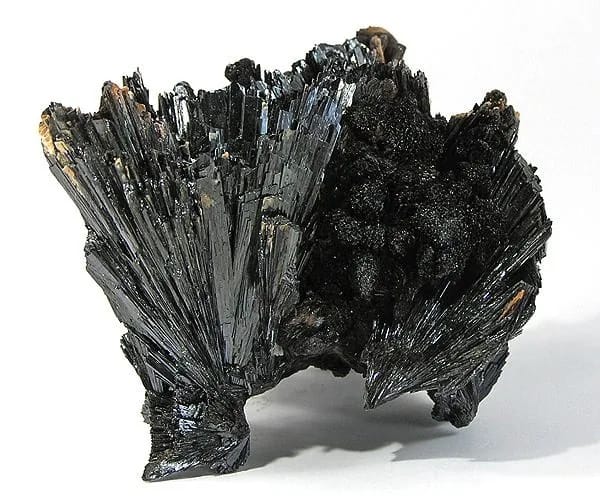
Botryoidal/radiating crystals show silky-fibrous luster.
Diaphaneity (Transparency)
opaque
Fibrous to massive; opaque.
Type Locality
Hollertszug Mine, Herdorf — Germany
Described 1806 by Lenz (named for J.W. von Goethe)
› Browse all type localities
Streak Test
yellow-brown
Same as limonite; FeO(OH) — most stable iron oxyhydroxide.
Streak = color of the powdered mineral. Drag specimen across unglazed white porcelain plate (Mohs 6.5). For minerals harder than the plate, crush a small flake into powder and observe color.
Market availability: Uncommon
Found at major shows and select dealers. Quality varies by locality.
Collector tier: Solid Display
Reliable mid-tier display species. Easy to find in well-formed examples; broad locality diversity.
Mohs 5–5.5
Vickers (~) 540 HV
Knoop (~) 620 HK
Geological setting
Oxidation zone
Diagnostic properties
Trace magnetism
Element composition by mass
Formula: FeO(OH) · molar mass: 88.85 g/mol
| Fe | 62.85% | |
| O | 36.01% | |
| H | 1.13% |
Computed from atomic weights (IUPAC 2021). Site-occupancy groups (Fe,Mn) split equally.
Mohs Hardness
5–5.5
Goethite sits at 5–5.5 on the Mohs scale — can be scratched by a steel knife.
Colors:
Streak
Yellow-brown
Yellow-brown
Crystal system
Orthorhombic
Orthorhombic
Pronunciation/ˈɡɜːrtaɪt/
Type localityHüttenberg, Carinthia, Austria
Discovery First described 1806 by Johann Georg Lenz (Germany)
Oxides & HydroxidesOxides (Hydroxides)
TL;DR · 1 min read
Goethite (FeO(OH)) is iron hydroxide — the principal iron mineral of laterite, gossan, and bog iron deposits. Named after the German polymath Goethe, it forms in low-temperature oxidized environments as botryoidal, fibrous, or radiating acicular masses.
Goethite (FeO(OH)) is iron hydroxide — the principal iron mineral of laterite, gossan, and bog iron deposits. Named after the German polymath Goethe, it forms in low-temperature oxidized environments as botryoidal, fibrous, or radiating acicular masses. Yellow streak distinguishes Goethite from hematite. Cornwall (England) and Pikes Peak (Colorado) supply collector specimens.