
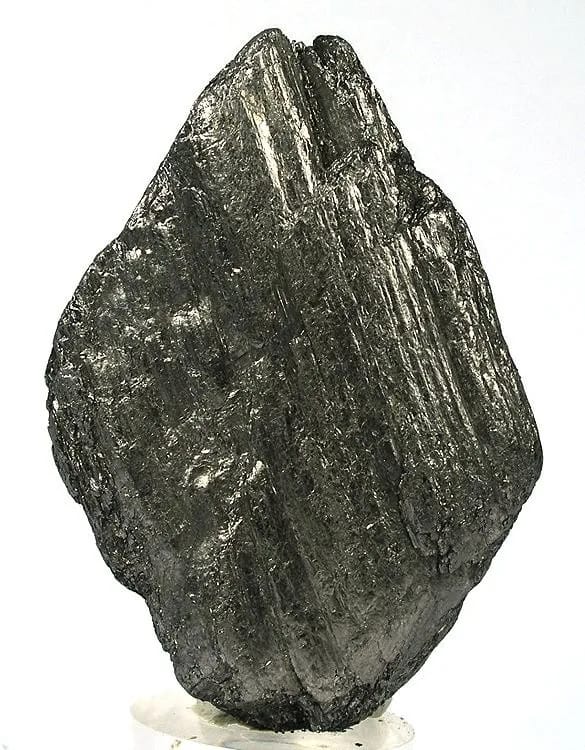
Crystal Structure
Hexagonal layered — sp² C-C bonds within sheets.
Elemental Composition (by mass)
| Element | Mass % | Visual |
|---|---|---|
| C Carbon | 100.00% |
Computed from simplified end-member formula. Solid-solution series, water content, and trace substitutions cause real-world variation.
IMA Abbreviation (Whitney-Evans 2010)
Gr
→ Graphite
Native carbon
Standard symbol from American Mineralogist (Whitney & Evans, 2010). Used in thin-section labeling, phase diagrams, and IMA-style species records.
Tenacity
Behavior:
flexible (sheets)
Under stress:
Sheets bend
Marks paper; greasy feel.
Luster
metallic→sub-metallic
Greasy metallic; marks paper.
Diaphaneity (Transparency)
opaque
Black metallic; greasy.
Diagnostic Field Tests
Marks paper→ Leaves dark gray streak
Soft (Mohs 1–2); greasy feel.
⚠ Use dilute HCl (~10%) only on inconspicuous spots; rinse promptly. Smell-tests should be brief and ventilated. Taste-test ONLY halite/sylvite — never lead, arsenic, or sulfur minerals.
Specific Gravity
2.09–2.23
g/cm³
very light
Greasy black, marks paper.
For comparison: water = 1.00, glass ≈ 2.5, quartz = 2.65, corundum ≈ 4.00, galena ≈ 7.50, gold ≈ 19.3.
Streak Test
black (greasy)
Greasy feel; marks paper. Distinguishes from molybdenite by streak color.
Streak = color of the powdered mineral. Drag specimen across unglazed white porcelain plate (Mohs 6.5). For minerals harder than the plate, crush a small flake into powder and observe color.
PolymorphsShares the formula
C with: Diamond · Lonsdaleite — same chemistry, different crystal structure.Mohs 1–2
Vickers (~) 1 HV
Knoop (~) 32 HK
Nickel–Strunz
1.CB.05aDana
01.03.06.02Geological setting
Metamorphic
Mohs Hardness
1–2
Graphite sits at 1–2 on the Mohs scale — soft enough to be scratched by a fingernail.
Colors:
Streak
Black
Black
Crystal system
Hexagonal
Hexagonal
Native ElementsNative Elements
TL;DR · 1 min read
Graphite (C) is one of the carbon polymorphs (with diamond and lonsdaleite). Its hexagonal layered structure produces the softest collectible mineral (Mohs 1–2) and an excellent dry lubricant.
Graphite (C) is one of the carbon polymorphs (with diamond and lonsdaleite). Its hexagonal layered structure produces the softest collectible mineral (Mohs 1–2) and an excellent dry lubricant. Graphite forms in metamorphic rocks (marble, schist) from the regional metamorphism of organic-rich sediments. The Sri Lanka and Madagascar deposits supply commercial flake graphite.