
Crystal Structure
FCC packing — Au atoms.
Elemental Composition (by mass)
| Element | Mass % | Visual |
|---|---|---|
| Au Gold | 100.00% |
Computed from simplified end-member formula. Solid-solution series, water content, and trace substitutions cause real-world variation.
IMA Abbreviation (Whitney-Evans 2010)
Au
→ Gold
Symbol = element
Standard symbol from American Mineralogist (Whitney & Evans, 2010). Used in thin-section labeling, phase diagrams, and IMA-style species records.
Pronunciation
/ɡoʊld/
↔ gold
Old English/Germanic
Birthstone & Anniversary Gift Reference
Anniversary years: 1th (gold), 50th (gold (golden)), 75th (diamond (diamond+gold))
› Full birthstones registry
Tenacity
Behavior:
malleable + ductile
Under stress:
Flattens under hammer; pulls into wire
Most malleable of all metals — 1 g pulls into 165m of fine wire.
Luster
metallic
Bright untarnishing metallic luster — diagnostic for natural gold.
Color Cause (Chromophore)
Chromophore:
d-electron plasmonic
Mechanism:
electron band transitions in Au
Color produced:
yellow
Au absorbs blue-violet light — only commonly-collected mineral whose color is from band-electron transitions.
Diaphaneity (Transparency)
opaque
Native metal.
Type Locality
(known since antiquity) — Worldwide
Source: Native element
› Browse all type localities
Magnetism
Category:
diamagnetic
Test result:
Slight repulsion
Native Au; diamagnetic. Distinguishes from native iron and meteorites which are ferromagnetic.
Test with rare-earth magnet (N42 or N52 neodymium). Suspend specimen on thread for sensitive paramagnetic detection. Diamagnetic minerals are weakly repelled (visible only with strong magnets like bismuth).
Diagnostic Field Tests
Streak→ Golden yellow
Distinguishes from pyrite (green-black streak).
Malleability→ Very malleable — flattens under hammer
Brittle minerals shatter.
⚠ Use dilute HCl (~10%) only on inconspicuous spots; rinse promptly. Smell-tests should be brief and ventilated. Taste-test ONLY halite/sylvite — never lead, arsenic, or sulfur minerals.
Specific Gravity
15.50–19.30
g/cm³
very heavy
Native gold — densest commonly collected mineral. Pure 19.3; less in electrum.
For comparison: water = 1.00, glass ≈ 2.5, quartz = 2.65, corundum ≈ 4.00, galena ≈ 7.50, gold ≈ 19.3.
Streak Test
golden yellow
Soft enough to mark porcelain easily — diagnostic vs pyrite/chalcopyrite.
Streak = color of the powdered mineral. Drag specimen across unglazed white porcelain plate (Mohs 6.5). For minerals harder than the plate, crush a small flake into powder and observe color.
Geological Setting
Environment:
multiple
Host rock:
quartz vein, placer, epithermal
Companions:
Hydrothermal vein-hosted (Mother Lode CA, Witwatersrand SA) or placer (alluvial).
Mohs 2.5–3
Vickers (~) 170 HV
Knoop (~) 185 HK
Nickel–Strunz
1.AA.05Dana
01.01.01.02Geological setting
HydrothermalPlacer
Mohs Hardness
2.5–3
Gold (Native) sits at 2.5–3 on the Mohs scale — can be scratched by a steel knife.
Colors:
Streak
Golden yellow
Golden yellow
Crystal system
Isometric (Cubic)
Isometric (Cubic)
Discovery Known since antiquity
Native ElementsNative Elements
TL;DR · 1 min read
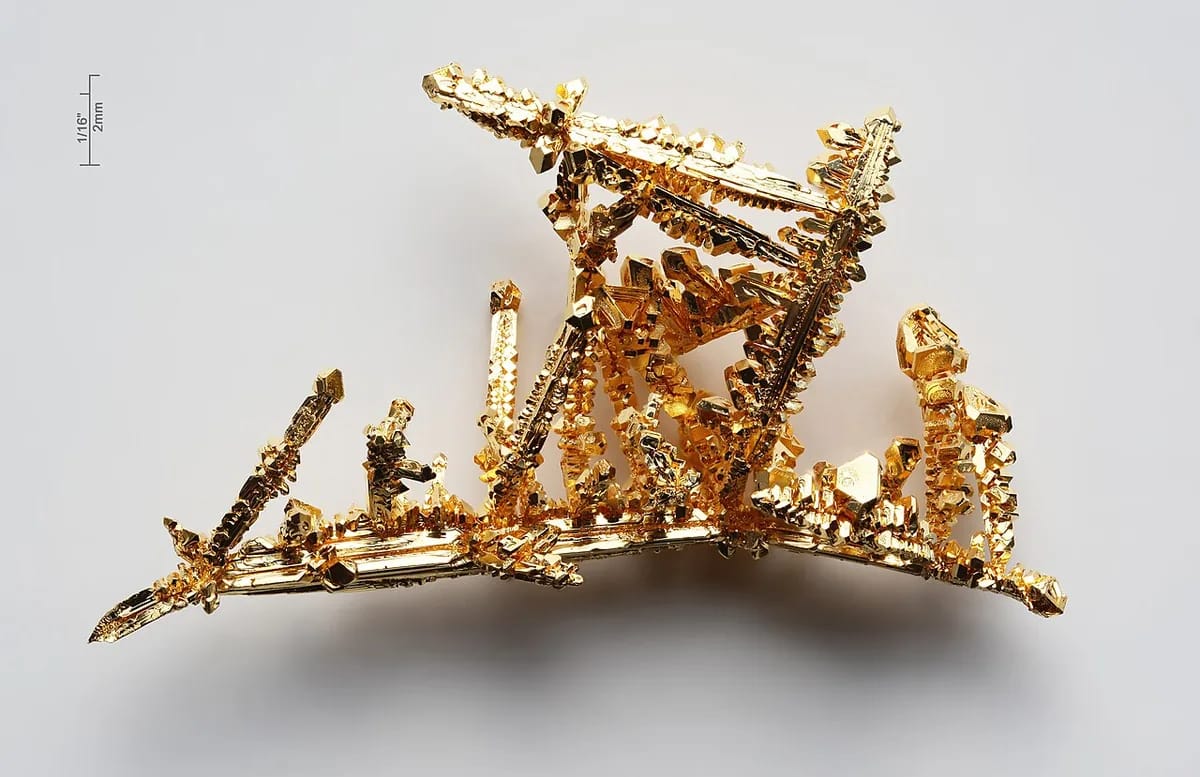
Native gold (Au) is the metallic element in its pure crystalline form — the most prized of all collector metals. Gold occurs as wire, leaf, dendrite, octahedral, and crystalline aggregates in hydrothermal quartz veins, alluvial placer deposits, and orogenic shear zones.
Native gold (Au) is the metallic element in its pure crystalline form — the most prized of all collector metals. Gold occurs as wire, leaf, dendrite, octahedral, and crystalline aggregates in hydrothermal quartz veins, alluvial placer deposits, and orogenic shear zones. The Witwatersrand (South Africa), Carlin (Nevada), and Yangshan (Gansu) belts are major modern producers.