
Elemental Composition (by mass)
| Element | Mass % | Visual |
|---|---|---|
| O Oxygen | 53.26% | |
| Si Silicon | 46.74% |
Computed from simplified end-member formula. Solid-solution series, water content, and trace substitutions cause real-world variation.
IMA Abbreviation (Whitney-Evans 2010)
Qz
→ Quartz
Variety of quartz
Standard symbol from American Mineralogist (Whitney & Evans, 2010). Used in thin-section labeling, phase diagrams, and IMA-style species records.
⏳ Long-term Aging & Care Timeline
pink fade (microfiber-related)years to decades
Trigger: sunlight
Intervention: Massive rose-quartz can lose pink slowly. Crystalline rose-quartz more stable.
Luster
vitreous→greasy
Massive rose quartz appears greasy due to fibrous texture.
Color Cause (Chromophore)
Chromophore:
dumortierite microfibers
Mechanism:
borosilicate nanofibers in massive quartz
Color produced:
pink
NOT a chromophore in quartz — pink color from oriented dumortierite fibrils.
Diaphaneity (Transparency)
translucent
Crystalline rose quartz can be transparent but massive rose quartz is translucent due to fibrous dumortierite.
Type Locality
—
Source: Variety of quartz
› Browse all type localities
Specific Gravity
2.65
g/cm³
light
Same as quartz.
For comparison: water = 1.00, glass ≈ 2.5, quartz = 2.65, corundum ≈ 4.00, galena ≈ 7.50, gold ≈ 19.3.
Geological Setting
Environment:
pegmatite
Host rock:
granitic pegmatite
Companions:
Massive rose quartz cores in pegmatite pods. Crystalline rose quartz is rare.
Treatments & Enhancements
Irradiationoccasionalunstable· detection: moderate
Rarely; some material darkened by gamma irradiation.
As a buyer: request written disclosure of treatments and confirm whether the price reflects treated or untreated material.
Characteristic Inclusions
Dumortierite fiberssolid★ diagnostic
Microscopic blue-gray fibers responsible for the pink color in massive rose quartz.
Rutile microneedlessolid
Oriented rutile needles produce asterism (star rose quartz).
★ Diagnostic inclusions are characteristic enough to help identify origin or species under 10× loupe.
Cleavage & Fracture
Cleavage:
none —
Fracture:
conchoidal
No cleavage; conchoidal fracture as in all quartz.
Market availability: Common
Widely available in most dealer stocks. Specimens span all price tiers.
Collector tier: Solid Display
Reliable mid-tier display species. Easy to find in well-formed examples; broad locality diversity.
Mohs 7
Vickers (~) 1400 HV
Knoop (~) 1100 HK
Geological setting
Pegmatite
Element composition by mass
Formula: SiO₂ (quartz var.) · molar mass: 60.08 g/mol
| O | 53.26% | |
| Si | 46.74% |
Computed from atomic weights (IUPAC 2021). Site-occupancy groups (Fe,Mn) split equally.
GroupQuartz Group (silica)
Optical Effects
Asterism
Mohs Hardness
7
Rose Quartz sits at 7 on the Mohs scale — harder than glass; scratches steel.
Colors:
Streak
White
White
Crystal system
Trigonal
Trigonal
Oxides & HydroxidesOxides (Silica Group)
TL;DR · 1 min read
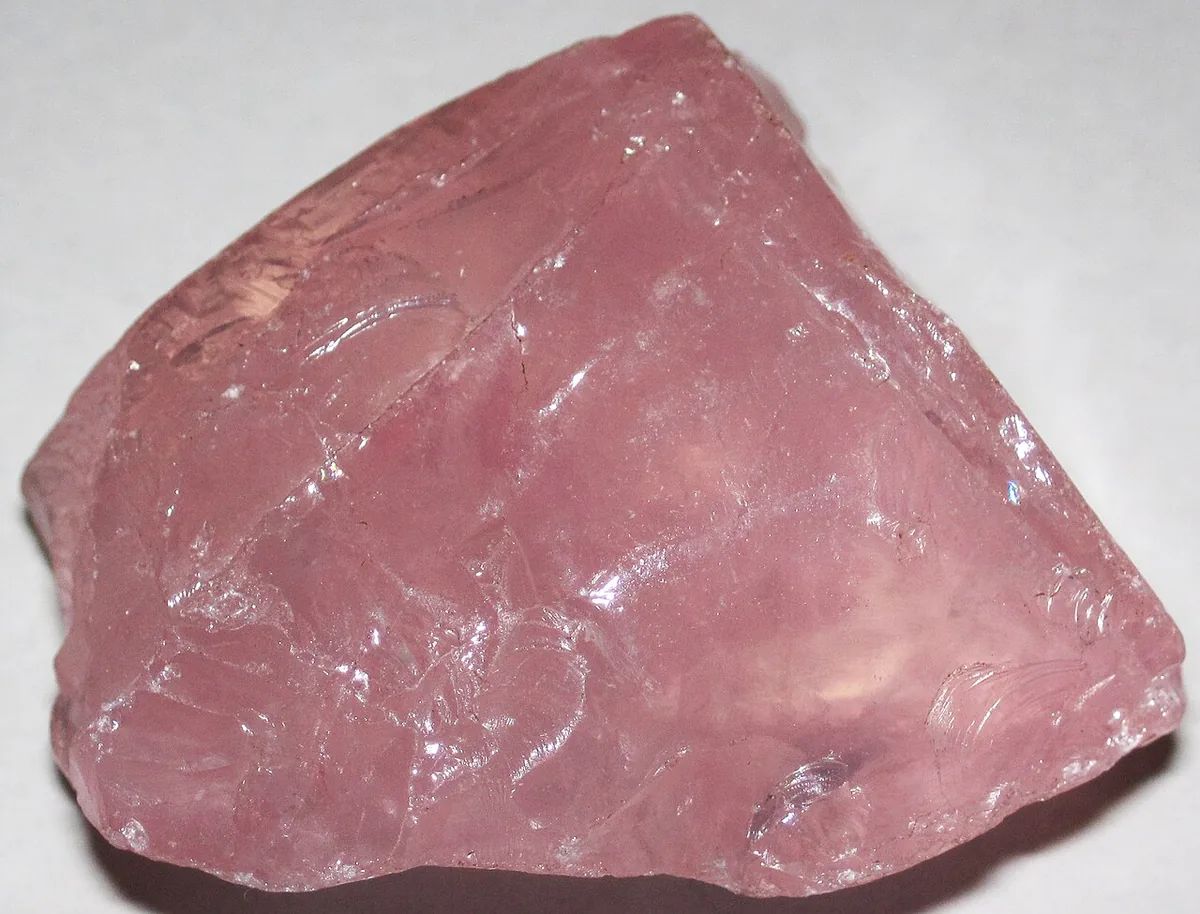
Rose Quartz is the pink to rose-red variety of quartz, colored by trace titanium and microscopic dumortierite-like fibrous inclusions. It typically forms in massive aggregates without crystal faces, though rare crystallized "Crystalline Rose Quartz" specimens exist from Brazilian pegmatite pockets (Pitorra Mine).
Rose Quartz is the pink to rose-red variety of quartz, colored by trace titanium and microscopic dumortierite-like fibrous inclusions. It typically forms in massive aggregates without crystal faces, though rare crystallized “Crystalline Rose Quartz” specimens exist from Brazilian pegmatite pockets (Pitorra Mine). The November birthstone alternative for topaz.