
Elemental Composition (by mass)
| Element | Mass % | Visual |
|---|---|---|
| O Oxygen | 40.81% | |
| Ti Titanium | 24.42% | |
| Ca Calcium | 20.45% | |
| Si Silicon | 14.33% |
Computed from simplified end-member formula. Solid-solution series, water content, and trace substitutions cause real-world variation.
IMA Abbreviation (Whitney-Evans 2010)
Ttn
→ Titanite
Same as sphene
Standard symbol from American Mineralogist (Whitney & Evans, 2010). Used in thin-section labeling, phase diagrams, and IMA-style species records.
Pronunciation
/ˈtaɪtənaɪt/
↔ TIE-tuh-nite
from titanium
Lapidary & Faceting Recommendations
Recommended cut:
oval / round brilliant
Also seen:
cushion, pear
Typical yield:
25% of rough
Same as sphene — synonym.
Luster
adamantine
High RI + high dispersion — strong fire on faceted material.
Diaphaneity (Transparency)
transparent
Same as sphene.
Type Locality
Passau — Germany
Described 1795 by Klaproth
› Browse all type localities
Specific Gravity
3.45–3.55
g/cm³
medium
Same as sphene.
For comparison: water = 1.00, glass ≈ 2.5, quartz = 2.65, corundum ≈ 4.00, galena ≈ 7.50, gold ≈ 19.3.
Twinning Laws
Contact twin {100}contact
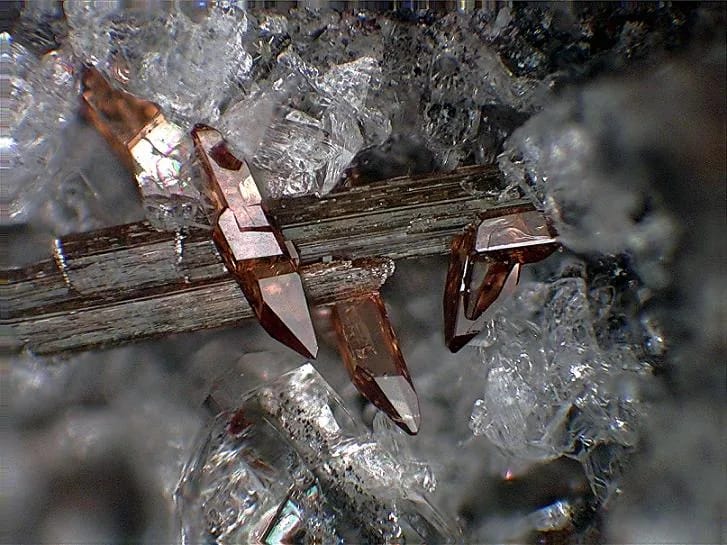
Wedge-shaped flattened twins common from Alpine clefts.
Pleochroism (trichroic)
Axis a
pale yellow
Axis b
reddish yellow
Axis c
green-yellow
Strength: strong
Same as sphene — synonym.
Mohs 5–5.5
Vickers (~) 540 HV
Knoop (~) 620 HK
Geological setting
Metamorphic
Element composition by mass
Formula: CaTiSiO₅ · molar mass: 196.03 g/mol
| O | 40.81% | |
| Ti | 24.42% | |
| Ca | 20.45% | |
| Si | 14.33% |
Computed from atomic weights (IUPAC 2021). Site-occupancy groups (Fe,Mn) split equally.
Optical Effects
diamond, demantoid)">High dispersion
Mohs Hardness
5–5.5
Titanite (Sphene) sits at 5–5.5 on the Mohs scale — can be scratched by a steel knife.
Colors:
Streak
White
White
Crystal system
Monoclinic
Monoclinic
SilicatesSilicates (Nesosilicates)
TL;DR · 1 min read
Titanite (CaTiSiO₅), historically called "sphene" for its wedge-shaped crystals, is a calcium-titanium silicate famous for adamantine luster, strong dispersion (higher than diamond! ), and emerald-green to honey-yellow gem material.
Titanite (CaTiSiO₅), historically called “sphene” for its wedge-shaped crystals, is a calcium-titanium silicate famous for adamantine luster, strong dispersion (higher than diamond!), and emerald-green to honey-yellow gem material. Pakistan (Skardu) and Brazil yield gem-quality crystals; metamorphic occurrences supply the larger collector specimens.