
IMA Abbreviation (Whitney-Evans 2010)
Ves
→ Vesuvianite
Skarn indicator
Standard symbol from American Mineralogist (Whitney & Evans, 2010). Used in thin-section labeling, phase diagrams, and IMA-style species records.
Pronunciation
/vəˈsuːviənaɪt/
↔ vuh-SOO-vee-uh-nite
from Vesuvius
Type Locality
Mt. Vesuvius — Italy
Described 1795 by Werner
› Browse all type localities
Market availability: Rare
Sought after; limited supply. Major shows and specialist dealers only.
Collector tier: Micromount / Niche
Best appreciated at thumbnail or smaller scale — often dull-colored, sub-millimeter, or radioactive. Specialist appeal.
Mohs 6.5
Vickers (~) 820 HV
Knoop (~) 870 HK
Nickel–Strunz
9.BG.35Dana
58.02.04.01Geological setting
MetamorphicSkarn
Element composition by mass
Formula: Ca₁₀(Mg,Fe)₂Al₄(SiO₄)₅(Si₂O₇)₂(OH)₄ · molar mass: 1453.62 g/mol
| O | 41.82% | |
| Ca | 27.57% | |
| Si | 17.39% | |
| Al | 7.42% | |
| Fe | 3.84% | |
| Mg | 1.67% | |
| H | 0.28% |
Computed from atomic weights (IUPAC 2021). Site-occupancy groups (Fe,Mn) split equally.
Mohs Hardness
6.5
Vesuvianite sits at 6.5 on the Mohs scale — harder than glass; scratches steel.
Colors:
Streak
White
White
Crystal system
Tetragonal
Tetragonal
Type localityMt. Vesuvius, Naples, Italy
SilicatesSilicates (Sorosilicates)
TL;DR · 1 min read
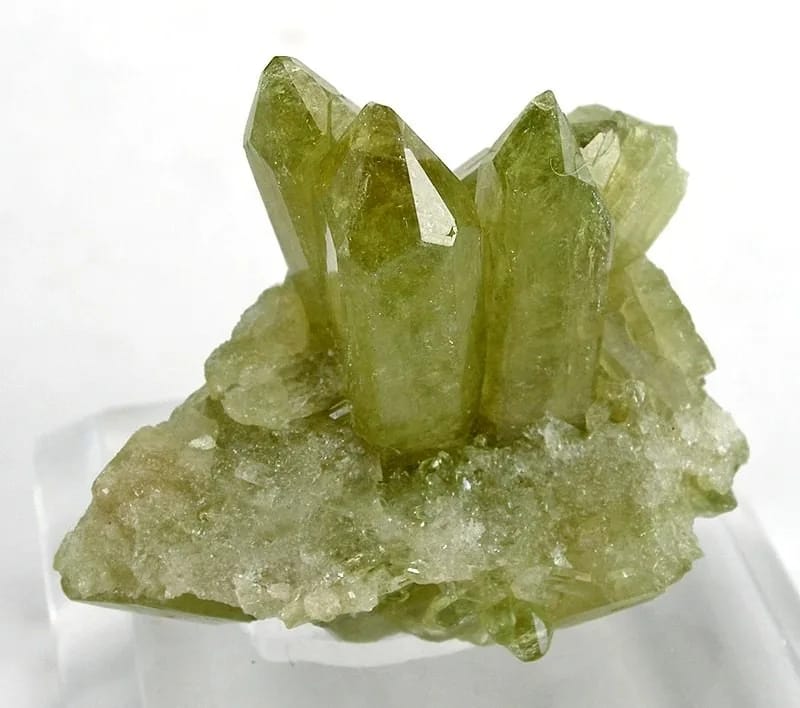
Vesuvianite (Ca₁₀(Mg,Fe)₂Al₄(SiO₄)₅(Si₂O₇)₂(OH)₄), historically called "idocrase," is a calcium-magnesium-aluminum sorosilicate that forms in contact-metamorphic skarns. It was first described in 1795 from blocks ejected by Mount Vesuvius, hence the name.
Vesuvianite (Ca₁₀(Mg,Fe)₂Al₄(SiO₄)₅(Si₂O₇)₂(OH)₄), historically called “idocrase,” is a calcium-magnesium-aluminum sorosilicate that forms in contact-metamorphic skarns. It was first described in 1795 from blocks ejected by Mount Vesuvius, hence the name. Color ranges from common olive-green and brown through rare blue (“cyprine,” with copper) and green-yellow gem material — the “californite” jade-substitute variety from California, and the cyprine variety from Norway are particular collector targets.
More minerals to explore
Tanzanite (坦桑石)
Orthorhombic
Hemimorphite (异极矿)
Orthorhombic
Epidote (绿帘石)
Monoclinic
Hardystonite (硅锌钙石)
Tetragonal
Zoisite (黝帘石)
Orthorhombic
Clinozoisite (斜黝帘石)
Monoclinic