
Crystal Structure
Orthorhombic Al₂SiO₅ — low-pressure polymorph.
Elemental Composition (by mass)
| Element | Mass % | Visual |
|---|---|---|
| O Oxygen | 49.37% | |
| Al Aluminum | 33.30% | |
| Si Silicon | 17.33% |
Computed from simplified end-member formula. Solid-solution series, water content, and trace substitutions cause real-world variation.
IMA Abbreviation (Whitney-Evans 2010)
And
→ Andalusite
Al₂SiO₅ polymorph
Standard symbol from American Mineralogist (Whitney & Evans, 2010). Used in thin-section labeling, phase diagrams, and IMA-style species records.
Pronunciation
/ˌændəˈluːsaɪt/
↔ an-duh-LOO-site
named for Andalusia
Lapidary & Faceting Recommendations
Recommended cut:
oval
Also seen:
cushion, pear, emerald
Typical yield:
30% of rough
Trichroic — cut to display red-green flash. Smaller stones (1-3 ct) show the effect best.
UV Fluorescence
SW (254 nm)
—
none
LW (365 nm)
Green
weak
Mostly inert.
SW = shortwave (germicidal lamp). LW = longwave (blacklight). Response varies with locality, trace impurities, and treatment.
Tenacity
Behavior:
brittle
Under stress:
Cleaves
Prismatic cleavage.
Luster
vitreous
Bright vitreous.
Color Cause (Chromophore)
Chromophore:
Fe²⁺-Ti⁴⁺
Mechanism:
intervalent charge transfer
Color produced:
brown-pink
Strong trichroism — different colors along different axes.
Diaphaneity (Transparency)
transparent-to-translucent
Strongly pleochroic gem material.
Type Locality
Almería — Spain
Described 1789 by Werner
› Browse all type localities
Specific Gravity
3.13–3.21
g/cm³
medium
Trichroic Al silicate.
For comparison: water = 1.00, glass ≈ 2.5, quartz = 2.65, corundum ≈ 4.00, galena ≈ 7.50, gold ≈ 19.3.
Pleochroism (trichroic)
Axis a
green
Axis b
red-brown
Axis c
yellow
Strength: very strong
Among the most pleochroic gems. Faceted andalusite shows simultaneous red-green-yellow flashes.
Cleavage & Fracture
Cleavage:
good 2 directions {110}
Fracture:
uneven
Chiastolite variety shows cross pattern.
Market availability: Rare
Sought after; limited supply. Major shows and specialist dealers only.
Collector tier: Micromount / Niche
Best appreciated at thumbnail or smaller scale — often dull-colored, sub-millimeter, or radioactive. Specialist appeal.
PolymorphsShares the formula
Al2SiO5 with: Kyanite · Sillimanite — same chemistry, different crystal structure.Mohs 6.5–7.5
Vickers (~) 1400 HV
Knoop (~) 1100 HK
Nickel–Strunz
9.AF.10Dana
52.02.02b.01Geological setting
Metamorphic
Element composition by mass
Formula: Al₂SiO₅ · molar mass: 162.04 g/mol
| O | 49.37% | |
| Al | 33.3% | |
| Si | 17.33% |
Computed from atomic weights (IUPAC 2021). Site-occupancy groups (Fe,Mn) split equally.
Optical Effects
Pleochroic
Mohs Hardness
6.5–7.5
Andalusite sits at 6.5–7.5 on the Mohs scale — harder than glass; scratches steel.
Colors:
Streak
White
White
Crystal system
Orthorhombic
Orthorhombic
Pronunciation/ˌændəˈluːsaɪt/
Discovery First described 1798 by Jean-Claude Delamétherie (Spain)
SilicatesSilicates (Nesosilicates)
TL;DR · 1 min read
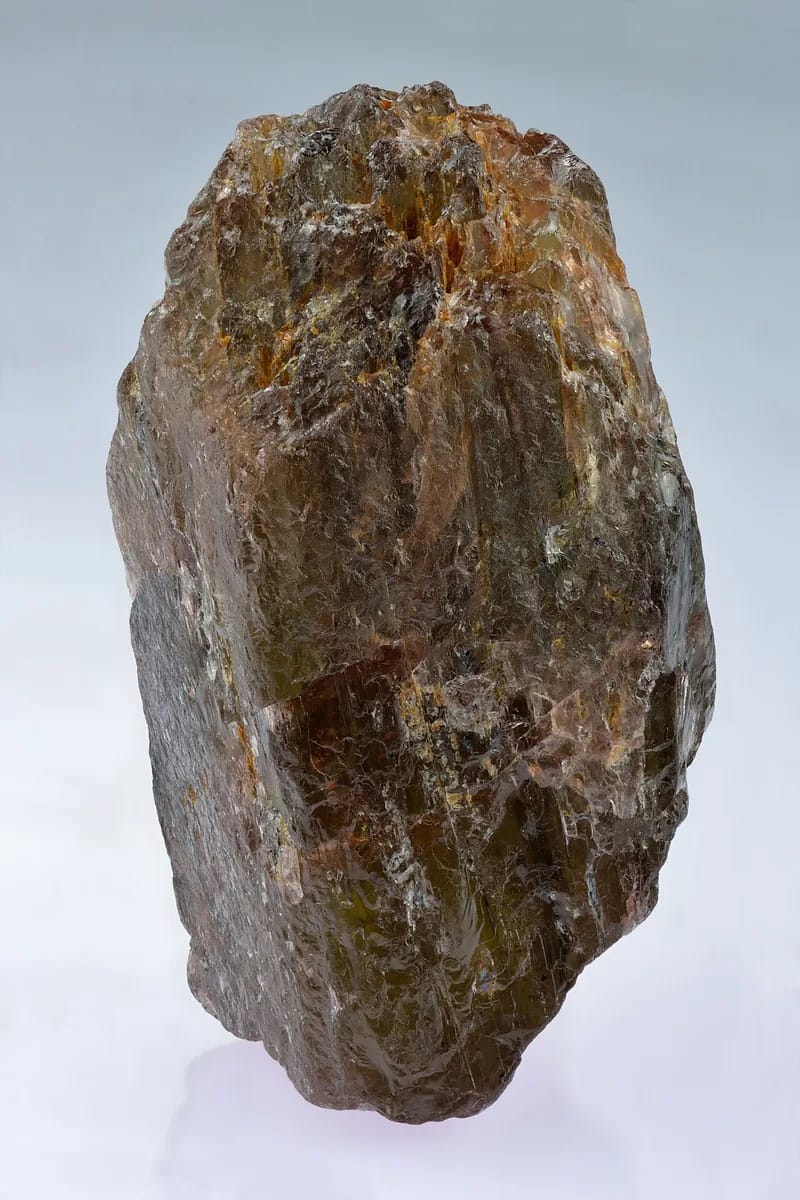
Andalusite (Al₂SiO₅) is the low-pressure aluminosilicate polymorph (with kyanite high-P and sillimanite high-T). Its name comes from Andalusia (Spain).
Andalusite (Al₂SiO₅) is the low-pressure aluminosilicate polymorph (with kyanite high-P and sillimanite high-T). Its name comes from Andalusia (Spain). The “chiastolite” variety contains carbonaceous cross-shaped inclusions producing iconic “fairy cross” patterns on cut sections — a longtime collector favorite from Madera (California) and Lancaster (Massachusetts).