Computed from simplified end-member formula. Solid-solution series, water content, and trace substitutions cause real-world variation.
IMA Abbreviation (Whitney-Evans 2010)
Sp
→ Sphalerite
Zn sulfide
Standard symbol from American Mineralogist (Whitney & Evans, 2010). Used in thin-section labeling, phase diagrams, and IMA-style species records.
Pronunciation
/ˈsfælərˌaɪt/
↔ SFAL-uh-rite
Greek "treacherous"
Lapidary & Faceting Recommendations
Recommended cut:
round brilliant
Also seen:
oval, cushion
Typical yield:
20% of rough
Extreme dispersion 0.156 (3x diamond) gives spectacular fire — but Mohs 3.5 too soft for jewelry use. Collector-grade only.
⚠ Safety & Handling
☠toxiclow
Mostly stable; trace cadmium in Cd-rich varieties.
Handling: Wash hands after extended handling.
Information provided in good faith. Consult local hazmat regulations for transport and disposal. Severely hazardous specimens may require special storage cabinets.
Luster
adamantine→resinous
High-RI sphalerite has adamantine; Fe-rich varieties more resinous.
Test with rare-earth magnet (N42 or N52 neodymium). Suspend specimen on thread for sensitive paramagnetic detection. Diamagnetic minerals are weakly repelled (visible only with strong magnets like bismuth).
Diagnostic Field Tests
Smell→ Rotten egg (H₂S) when struck
Zn sulfide — H₂S released from fresh fractures.
UV test→ Fluoresces orange-red (some specimens)
Phosphorescent material from Franklin NJ.
⚠ Use dilute HCl (~10%) only on inconspicuous spots; rinse promptly. Smell-tests should be brief and ventilated. Taste-test ONLY halite/sylvite — never lead, arsenic, or sulfur minerals.
Specific Gravity
3.90–4.10
g/cm³
heavy
High variability with Fe content.
For comparison: water = 1.00, glass ≈ 2.5, quartz = 2.65, corundum ≈ 4.00, galena ≈ 7.50, gold ≈ 19.3.
Streak Test
brown / yellow
Fe content shifts streak from pale yellow (low-Fe) to brown (high-Fe).
Streak = color of the powdered mineral. Drag specimen across unglazed white porcelain plate (Mohs 6.5). For minerals harder than the plate, crush a small flake into powder and observe color.
Geological Setting
Environment:
hydrothermal
Host rock:
hydrothermal vein, Mississippi Valley type, volcanogenic massive sulfide
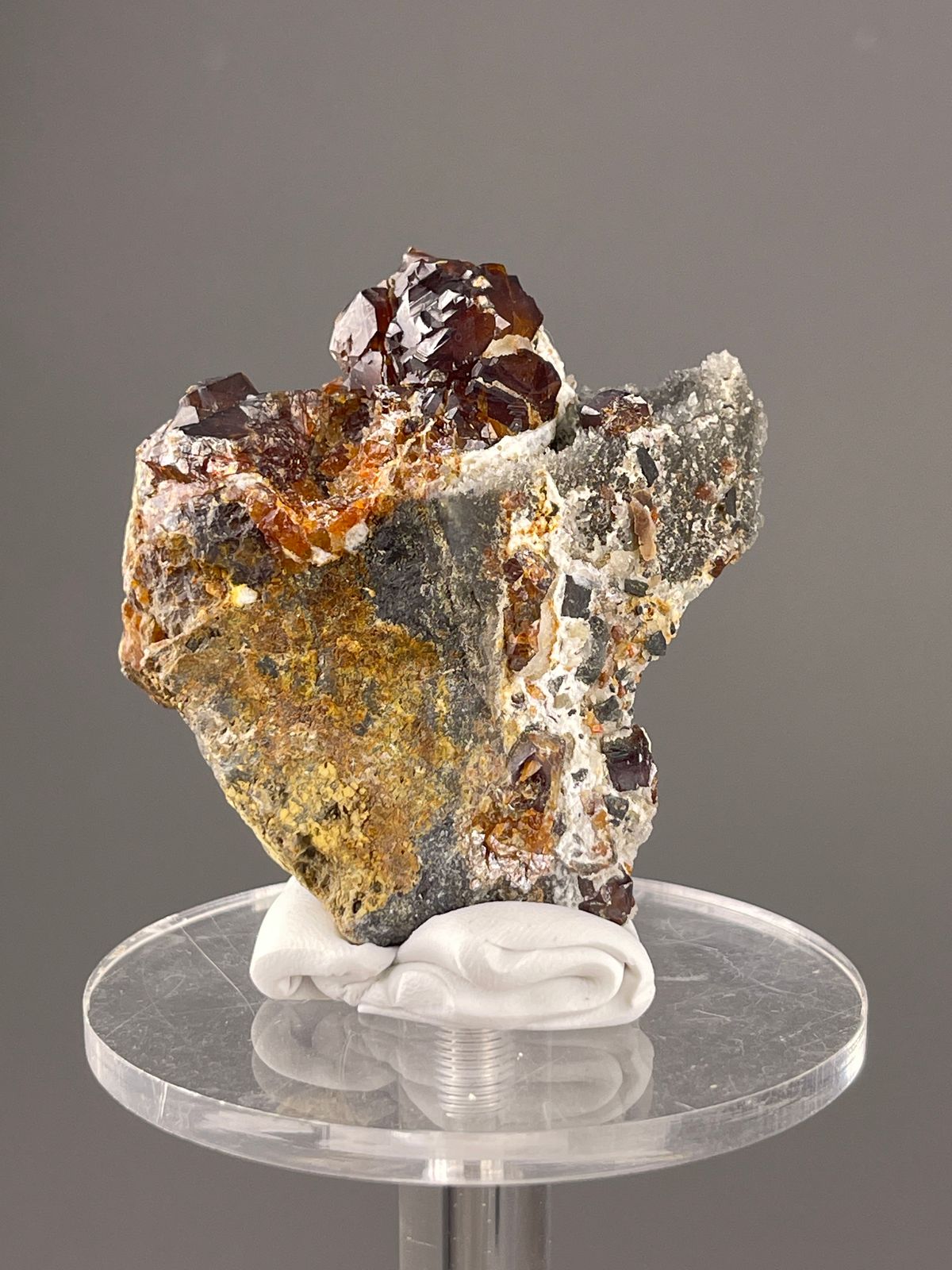
Sphalerite is the world's primary ore of zinc and the source of nearly all collectable Zn-bearing crystal specimens. Its (Zn,Fe)S chemistry produces the full color range from honey-yellow "cleiophane" through ruby-red "marmatite" to opaque iron-rich black.
Sphalerite is the world’s primary ore of zinc and the source of nearly all collectable Zn-bearing crystal specimens. Its (Zn,Fe)S chemistry produces the full color range from honey-yellow “cleiophane” through ruby-red “marmatite” to opaque iron-rich black. Tetrahedral and dodecahedral crystal forms with adamantine luster make sphalerite a perennial collector favorite.
Notable Chinese Localities
Dexing (Jiangxi) and Daye (Hubei) produce dark high-Fe sphalerite as porphyry copper byproduct. Yaogangxian (Hunan) and Huanggang (Inner Mongolia) yield gemmy crystals up to several cm.
Cite this entry
APA
MyMineralBox Editorial Team. (2026). Sphalerite. My Mineral Box. Retrieved May 23, 2026, from https://mymineralbox.com/mineral-encyclopedia/minerals/sphalerite/
MLA
MyMineralBox Editorial Team. "Sphalerite." My Mineral Box, 2026, https://mymineralbox.com/mineral-encyclopedia/minerals/sphalerite/. Accessed May 23, 2026.
Chicago
MyMineralBox Editorial Team. "Sphalerite." My Mineral Box. Last modified May 4, 2026. https://mymineralbox.com/mineral-encyclopedia/minerals/sphalerite/.
BibTeX
@misc{mmb_sphalerite,
 author = {{MyMineralBox Editorial Team}},
 title = {{Sphalerite}},
 year = {2026},
 publisher = {My Mineral Box},
 url = {https://mymineralbox.com/mineral-encyclopedia/minerals/sphalerite/},
 urldate = {2026-05-23}
}
About Sphalerite
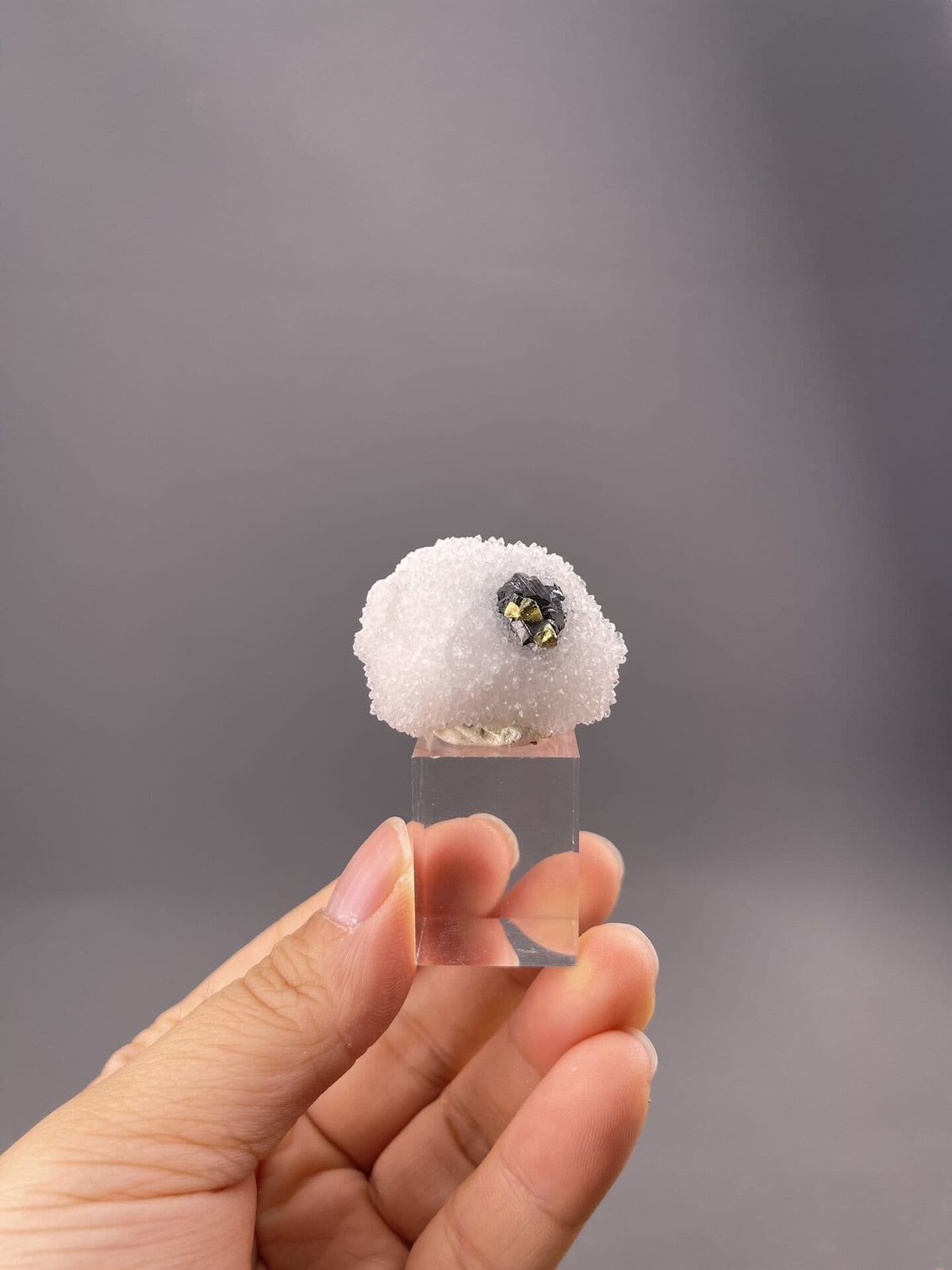
Sphalerite belongs to the sulfide class in the sphalerite group and has the chemical formula ZnS. It crystallizes in the isometric system and is one of the most visually varied minerals in the collector market. Its combination of structural character and global distribution make it a recognized species in both systematic and aesthetic collections.
Identification & care
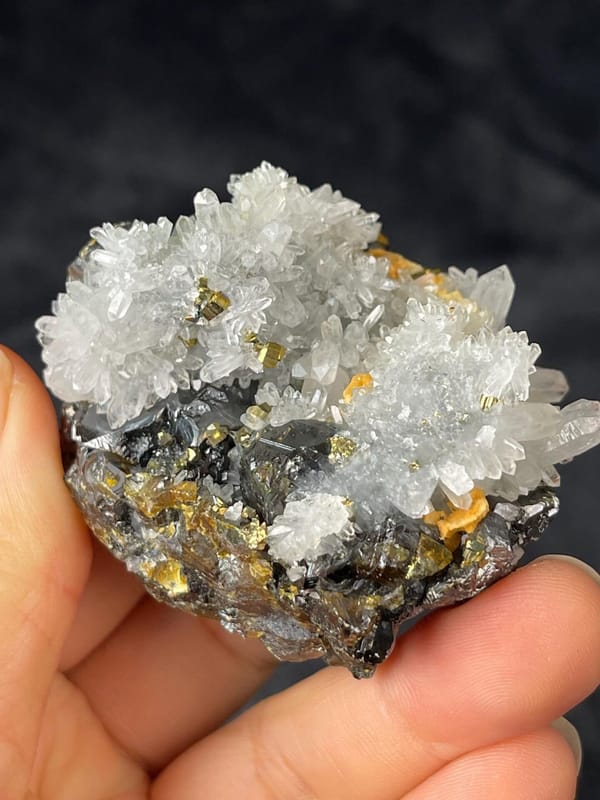
Sphalerite typically forms tetrahedral, dodecahedral; massive, granular; botryoidal (rare). Its color range is broad, including yellow, orange, red, brown, black, green, and colorless. The luster is adamantine, resinous, sub-metallic, the streak is white to yellow, and specimens range from transparent to opaque. The cleavage is perfect dodecahedral {110} in 6 directions. The fracture is conchoidal, which aids identification.
Collector context
How it forms
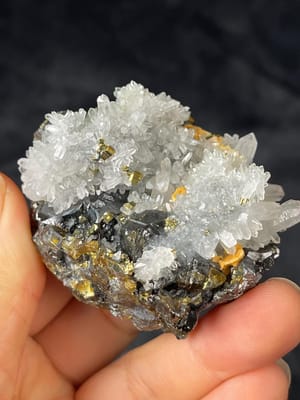
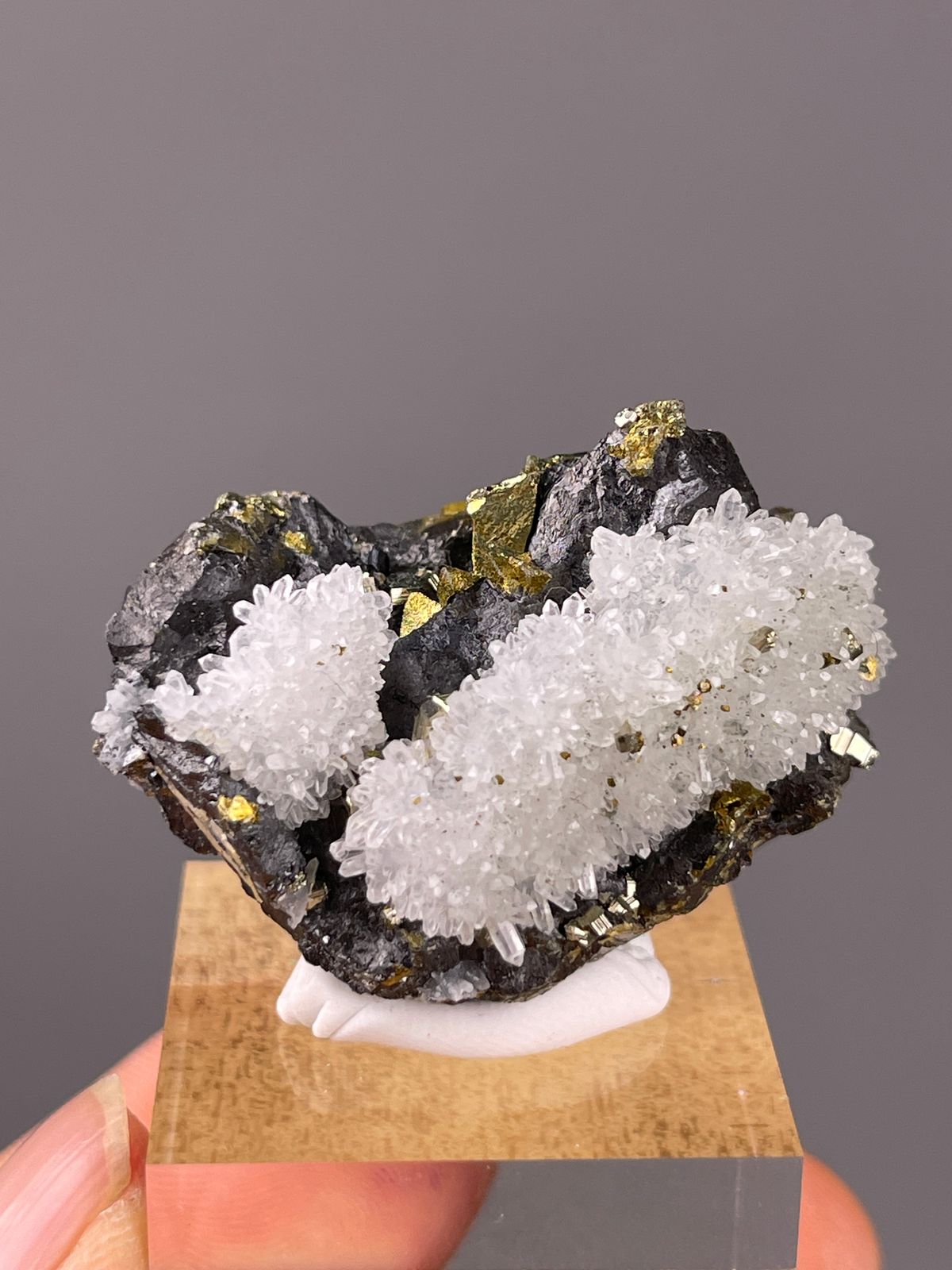
The geological setting for Sphalerite is typically hydrothermal vein deposits; mississippi valley type (mvt); skarn; seafloor massive sulfide. It is commonly found in association with galena, pyrite, chalcopyrite, calcite, fluorite, barite.
Classic Chinese localities
Sphalerite also appears as a secondary or late-stage occurrence at 1 additional Chinese localities.
Why collectors care
Sphalerite is a frequently-sought species in serious collections because its habit is recognizable, its color often strong, and its best examples unmistakable even at a distance. Chinese material has driven much of the recent visual shift in the species — sharper crystals, deeper colors, cleaner matrix.
What affects value
Value in Sphalerite is assessed, in typical order of weight, against: (1) locality provenance; (2) size relative to the species norm; (3) crystal form and termination sharpness; (4) color saturation and zoning; (5) transparency and internal clarity; (6) matrix quality and aesthetic balance; (7) condition (absence of damage, chips, or repair). Cleaning quality and verified locality documentation act as multipliers across the above.
Naming history
Sphalerite is Greek sphaleros, "deceptive" or "treacherous" — a name given in frustration. It sits with galena and looks metallic and promising, but yields no lead, and German miners called it Blende, from blenden, "to blind" or "deceive," for the same reason. It turned out to be the world's principal ore of zinc, so the deception was temporary.
Frequently asked questions
What is Sphalerite?
Sphalerite has the chemical formula ZnS, crystallises in the Isometric system, has a Mohs hardness of 3.5–4. Sphalerite is a sulfide mineral prized by collectors for its exceptional color range, with several world-class Chinese localities.
What is the chemical formula of Sphalerite?
The chemical formula of Sphalerite is ZnS.
What crystal system does Sphalerite belong to?
Sphalerite crystallises in the Isometric crystal system.
Where is Sphalerite found?
Notable localities for Sphalerite include Fankou Pb-Zn Mine, Dabaoshan Polymetallic Mine, Dalnegorsk, Broken Hill, China.
Is Sphalerite rare?
As a collector mineral, Sphalerite is generally considered common.
We use a small set of cookies (analytics, checkout, chat) to keep the site working and understand how visitors use it. Checkout-essential cookies are always loaded. Privacy policy